
NEGOCOACH
261
Origin : FBI · Chris Voss

🕵️ FBI · Chris Voss

Tactical empathy

Chris Voss, "Never Split the Difference", 2016, FBI crisis negotiation.

Full detail in the “Origin & history” section below.

261

Emotional Calibration

Emotional intelligence Technique 261 / 360
Alexandre Baumberger

Author of the library

Alexandre Baumberger

Negotiation lecturer at KEDGE Business School

A rare threefold background serving negotiation: teaching, commercial justice and audit, backed by experience as a company director in Bordeaux.

  • Teaching, KEDGE Business School Negotiation lecturer since 2014 (12 years).
  • Commercial justice, Commercial Court Judge from 2018 to 2026: litigation, then insolvency proceedings.
  • Audit & advisory, over 20 years Tax, employment and financial audit in major firms, for large groups.
In brief

Emotional calibration is the ability to read the other party's emotional state with precision in real time, micro-expressions, tone, pace, silences, and to adjust one's own behaviour accordingly. It is the perceptual foundation of every emotional technique: without an accurate reading, a label or a mirror falls wide of the mark. It belongs to the emotional intelligencei described by Daniel Goleman.

Reading level

At a glance

Its family profile at a glance

Effectiveness Psychologicalimpact Discretion Preparation Relationalrisk Ethics
8.0 / 10 Tactical potential

Vigilance: moderate (4.0/10) · Preparation required: 6/10

Grounding in the source school School grounded in research and field practice

Indicative profile: it situates the “Emotional intelligence” family as the FBI · Chris Voss school practises it, not this technique taken in isolation. Techniques from the same family and school therefore share the same profile. NEGOCOACH editorial rating out of 10, non-experimental · the higher the “relational risk” value, the more costly the technique is to the relationship.

NEGOCOACH assessment

How to read this rating

Tactical potential 8.0/10 (effectiveness, impact, discretion) and vigilance moderate (relational and ethical risk): two distinct readings, deliberately never merged into a single score that would reward risk. NEGOCOACH editorial rating calibrated from the “Emotional intelligence” family and the “FBI · Chris Voss” school. Each criterion is rated out of 10; click to understand what it measures.

  • Effectiveness 8/10 · Very high

    How far the technique can carry the negotiation in the intended direction when it is well executed.

  • Psychological impact 10/10 · Very high

    Strength of the effect produced on the counterpart's perceptions, emotions and decisions.

  • Discretion 6/10 · High

    How hard it is for the other party to notice the technique is being used. A high value = very discreet.

  • Preparation 6/10 · High

    The information, analysis and rehearsal required upfront to use it effectively.

  • Relational risk 3/10 · Low

    Potential cost to the relationship and to trust if the technique is spotted, refused or fails. A high value = riskier.

  • Ethics 6/10 · High

    Moral acceptability: fairness, transparency and respect for the counterpart's autonomy. A high value = more defensible.

Level of evidence

School grounded in research and field practice

The school this technique stems from combines academic work with long field practice. This indicator qualifies the school, not this technique taken in isolation.

Indicative NEGOCOACH editorial rating, for teaching purposes. For “Relational risk”, a high value signals a cost to the relationship, not a quality.

Summary of Emotional Calibration


Origin & history

The concept is rooted in the work on emotional intelligence by Salovey and Mayer (1990), popularised by Daniel Goleman (Emotional Intelligence, 1995), and in Paul Ekman'si research on universal facial micro-expressions. The term « calibration » itself comes from NLP, where it denotes the fine observation of an interlocutor's non-verbal signals.


Definition and principle

To calibrate is to establish a person's emotional baseline and then to spot significant deviations (a voice that tightens, a gaze that avoids, a pace that quickens) in order to infer their true state. The skill is twofold: to perceive accurately and to adjust without delay one's tone, pace and words. Poorly calibrated, an intervention that is sound in substance fails through a misreading of the moment.


Concrete examples of application

Application by context

The same technique, across every negotiation settings

Context 1 / 8

Sales negotiation

A salesperson notices that, the moment they mention a three-year commitment, the client leans back and folds their arms. They calibrate this cooling, immediately drop the argument about duration and propose a short trial, unlocking the sale.

How to apply it

Spot the withdrawal signal (posture, tone) at the precise moment it appears and adjust the offer in real time, without waiting for the verbal objection.

Strengths

Corrects course before the objection hardens; shows a rare attentiveness that reassures.

Weaknesses

Over-interpretation (seeing a refusal in a mere gesture) leads to abandoning a sound argument too quickly.
Context 2 / 8

Procurement negotiation

The buyer watches the salesperson: when they state their budget, the seller hesitates for a fraction of a second before saying « that's tight ». This micro-signal tells the buyer there is still room, and they hold their position without giving ground.

How to apply it

Calibrate the seller's micro-hesitations around price; the gap between the firm words and the non-verbal signal betrays the real flexibility.

Strengths

Detects the seller's tipping point and avoids conceding out of excessive caution.

Weaknesses

Reading a hesitation where there is none leads to overplaying firmness and causing the deal to collapse.

Context 3 / 8

Labour negotiation

In an annual review, a manager senses that beneath an employee's polite answers there is a weariness (flat delivery, forced smiles). They calibrate this discrepancy and change tack: « How are you really doing at the moment? », opening up a genuine conversation.

How to apply it

Compare the words and the non-verbal; when they diverge, address the non-verbal, which is more revealing than the words.

Strengths

Brings out the real issue beneath the facade and forestalls silent disengagement.

Weaknesses

An intrusive reading of the non-verbal can make the other party uncomfortable if they are not ready to open up.

Context 4 / 8

Crisis management

A negotiator continuously tracks the vocal intensity of the person: every rise signals a sensitive point to steer around, every lull an opening. They match their own delivery to the other's in order to calm them gradually.

How to apply it

Take the voice as a real-time indicator and synchronise your pace with theirs before gently slowing it down to de-escalate.

Strengths

Allows de-escalation to be steered signal by signal, where any error of timing is costly.

Weaknesses

Demands total attention and training; fatigue or stress quickly degrade the fineness of the reading.

Context 5 / 8

Political negotiation

In a multilateral negotiation, a mediator observes the glances exchanged within a delegation at each proposal. They calibrate the signs of internal disagreement and adapt their wording to preserve the cohesion of the opposing party.

How to apply it

Calibrate the group dynamics (glances, internal tensions) as much as the spokesperson's emotion; the real blockage is sometimes internal to the camp.

Strengths

Reveals the opposing camp's fault lines and allows the offer to be adjusted so that it will carry internally.

Weaknesses

Group signals are ambiguous; a misreading may lead one to bet on a non-existent division.

Context 6 / 8

Real-estate negotiation

During a viewing, the agent notes the exact moment when the buyer's gaze lingers and her tone softens, in front of the kitchen. They calibrate this peak of interest and centre their negotiation on that room, an emotional lever identified live.

How to apply it

Spot the peak of emotional interest during the viewing and lean on it when the time comes to discuss price.

Strengths

Identifies the real emotional trigger of the purchase, often different from the stated criterion.

Weaknesses

A misread signal of enthusiasm can lead one to overestimate the commitment and misjudge the negotiation.

Context 7 / 8

Cross-cultural negotiation

A Western negotiator learns that a prolonged silence, which he took for disagreement, in fact signals respect and reflection for his Japanese partner. He recalibrates his reading of the signals in the light of the local culture.

How to apply it

Recalibrate your reading framework according to the culture: the same signal (silence, eye contact, a smile) does not carry the same emotional value everywhere.

Strengths

Avoids the major emotional misreadings that derail international negotiations.

Weaknesses

Applying one's own reading framework to another culture produces systematic errors of interpretation.

Context 8 / 8

Family negotiation

During a sensitive discussion, a relative senses that the other's voice trembles slightly beneath the apparent anger: it is fear, not aggression. They calibrate this true emotional undercurrent and respond to the fear, defusing the conflict.

How to apply it

Distinguish the displayed emotion from the real emotion (anger masking fear) and respond to the latter; it is the one that drives the behaviour.

Strengths

Avoids responding to the aggressive surface and addresses the cause, preserving the relationship.

Weaknesses

In a situation where one is oneself emotionally involved, an accurate reading becomes very hard to maintain.


Counter-techniques

Spot and neutralise this technique

Negotiation is also played on defence. Here is how to recognise this technique when it is used against you, and turn it around.

Detect

The signals that give it away

  • Displayed empathy that lowers your guard
  • Mirroring of your gestures and words
  • A systematic "I understand you"

Neutralise

The counters that defuse it

  • Appreciate the warmth without relaxing
  • Keep your objectives in mind
  • Distinguish being heard from being satisfied

Turn around

Turn it into an advantage

Use active listening in turn to gather information.

The trap to avoid

Mistaking being understood for having won your case.

In brief

  • Difficulty: Advanced
  • Estimated effectiveness: Very high
  • Time to implement: Continuous, throughout the exchange
  • Fields of application: Crisis negotiation, Sales, Management, Diplomacy, Mediation
  • Synonyms: Emotional reading, Attunement, Emotional adjustment
  • Tags: calibration, emotional intelligence, Goleman, micro-expressions, Ekman

Strengths and weaknesses

Emotional calibration is the perceptual foundation of all other techniques: without an accurate reading of the other's state, a label, a mirror or a projection falls wide of the mark. Well practised, it allows continuous adjustment and the handling of the true emotion. Its weakness: it is a demanding and tiring skill, highly sensitive to over-interpretation and cultural biases.


When to use this technique?

To be deployed at all times, as the listening backdrop of every negotiation, and particularly when words and the non-verbal diverge. Decisive in a crisis and on the international stage. Its limit: never turn a reading into a certainty; a signal is verified (through a label, a question), it is not decreed.


How to recognise and counter this technique

Recognise: the other watches you intently, adjusts their tone to yours and reacts to your micro-reactions more than to your words. Neutralise: control your signals (steady delivery, neutral face, no reaction to anchors) to blur their reading. Turn it around: calibrate them in turn and test their reactions with small deliberate signals to map their sensitive points.


Limits and ethics

Calibration becomes problematic when it is used to exploit the emotional weaknesses detected (fear, grief, dependence) in order to extract an agreement. The ethical line rests on the use: reading to understand and adjust is legitimate; reading to manipulate vulnerability is not. It also demands constant caution in the face of the risk of misinterpretation.


Variants and related techniques

The common basis of Tactical empathy, Labeling and Verbal mirroring, which it guides in real time. Close to therapeutic attunement and to non-verbal synchronisation. Self-calibration (self-regulation) is its inner counterpart: reading and mastering one's own signals as much as those of the other.


To go further

  • Daniel Goleman, Emotional Intelligence: Why It Can Matter More Than IQ, 1995.
  • Paul Ekman, Emotions Revealed: Recognizing Faces and Feelings to Improve Communication, 2003.
  • Peter Salovey & John Mayer, « Emotional Intelligence », Imagination, Cognition and Personality, 1990.

Objectives of the technique

  • Establish the interlocutor's emotional baseline at the start of the exchange in order to spot significant deviations thereafter (tone, delivery, posture, gaze).
  • Detect in real time the gaps between the words and the non-verbal so as to identify the real emotion behind the displayed one.
  • Immediately adjust one's tone, pace and arguments to the perceived emotional state, rather than running through a prepared script.
  • Choose the right emotional moment to put forward an offer, place a label or leave a silence.
  • Prevent escalation by spotting the signals of tension before they turn into a head-on objection or a breakdown.

Famous cases

Diplomatic · Camp David 1978: Begin's tears and the revival of the negotiation: Documented case. On the thirteenth day of the Camp David summit (September 1978), the talks were at a standstill: Menachem Begin refused to dismantle the settlements in the Sinai and was preparing to leave. He had asked for signed photographs of the summit for his eight grandchildren; Jimmy Carter had the first name of each child inscribed on every one, along with a wish for peace. As he handed them to Begin, Carter watched his reaction: the Prime Minister's lips trembled and his eyes welled up as he read the names one by one. Sensing this emotional shift, Carter let the emotion work without forcing it. Begin put down his bags and declared: « Mr President, I will make one last attempt. » The accords were signed on 17 September 1978, and the Israeli-Egyptian peace treaty followed in March 1979. The episode illustrates emotional calibration: reading the other's true state at the decisive moment and adjusting one's conduct to that signal rather than to the stated positions.

Commercial · The renewal that quietly goes off the rails (representative scenario): Representative scenario, with no reference to real persons. A key-account manager is preparing the renewal of a software contract with a loyal client. Within the first few minutes, she notes a departure from her interlocutor's usual baseline: a flatter tone, brief answers, an absence of the customary banter. Rather than running through her renewal presentation, she calibrates this cooling and changes plan: « Before we talk about the contract, I have the impression that something has changed on your side. What's going on? » The client then reveals that a competitor has approached him with an aggressive offer and that his management is asking him to justify every budget line. The negotiation refocuses on this real issue: she co-builds an ROI justification file and adjusts the scope. Without this reading of the emotional gap, she would have run through an off-topic pitch and discovered the competing offer only once the client had left.


Common mistakes

  • Interpreting an isolated gesture outside any baseline (« folded arms = closed off »): it is the deviation from the person's usual behaviour that informs, never the sign in itself.
  • Turning a reading into a certainty without verifying it through a label or an open question: an emotional signal is a hypothesis to be tested, not an established fact.
  • Over-interpreting a mere movement of discomfort and abandoning a sound argument too quickly, when the signal reflected only a passing unease.
  • Applying one's own cultural framework: a silence, an averted gaze or an impassive face do not carry the same emotional meaning across cultures.
  • Concentrating on reading the other to the point of neglecting one's own signals: under fatigue or stress, calibration degrades into a projection of one's own emotions onto the interlocutor.

Scientific foundations

  • Peter Salovey & John D. Mayer (1990) Emotional Intelligence Imagination, Cognition and Personality, vol. 9, no. 3, pp. 185-211, DOI: 10.2190/DUGG-P24E-52WK-6CDG
  • Daniel Goleman (1995) Emotional Intelligence: Why It Can Matter More Than IQ Bantam Books, New York
  • Paul Ekman (2003) Emotions Revealed: Recognizing Faces and Feelings to Improve Communication and Emotional Life Times Books, New York

Quick exercise

Test yourself before answering

Answer in your head, then reveal the solution. Memory is built through active recall.

1 Quels signaux doivent vous alerter ?
  • Displayed empathy that lowers your guard
  • Mirroring of your gestures and words
  • A systematic "I understand you"
2 Quelles parades appliquer ?
  • Appreciate the warmth without relaxing
  • Keep your objectives in mind
  • Distinguish being heard from being satisfied

Frequently asked questions

The questions we get most

What is the "Emotional Calibration" technique?

Emotional calibration is the ability to read the other party's emotional state with precision in real time, micro-expressions, tone, pace, silences, and to adjust one's own behaviour accordingly. It is the perceptual foundation of every emotional technique: without an accurate reading, a label or a mirror falls wide of the mark. It belongs to the emotional intelligencei described by Daniel Goleman.

Is the "Emotional Calibration" technique ethical?

It sits on the line: effective, but it can tip into manipulation if it exploits an information asymmetry. Use it with measure and without deliberate deceit.

How do you defend against "Emotional Calibration"?

Mistaking being understood for having won your case. The right reflex: appreciate the warmth without relaxing.

What is the "Emotional Calibration" technique based on?

NEGOCOACH does not assess the experimental validation of this technique in isolation. What we document is the grounding of its source school (FBI · Chris Voss): school grounded in research and field practice. Full detail is in the "At a glance" section of this page.

Practise with AI

Three ready-to-use prompts

Copy, paste into your assistant, replace the [brackets]. Works with ChatGPT, Claude, Gemini, Mistral, Perplexity.

Prepare

Build your plan before the meeting

You are an expert negotiation coach. Help me prepare to use the "Emotional Calibration" technique in the following situation: [describe your situation]. Give me: the conditions for success, a 3-step script, my counterpart's likely objections and how to answer them.

Simulate

Rehearse against an AI counterpart

Play the role of my counterpart in a negotiation. I am going to test the "Emotional Calibration" technique. React realistically and with resistance, do not give in too quickly, then at the end analyse my performance and suggest 3 concrete improvements.

Debrief

Analyse a past negotiation

Here is how my negotiation went: [paste the exchanges]. Analyse whether the "Emotional Calibration" technique was used well, what worked, the mistakes made, and spell out precisely what I could have done better.

References

Bibliography & credible sources

Founding works of the 🕵️ FBI · Chris Voss school this technique belongs to.

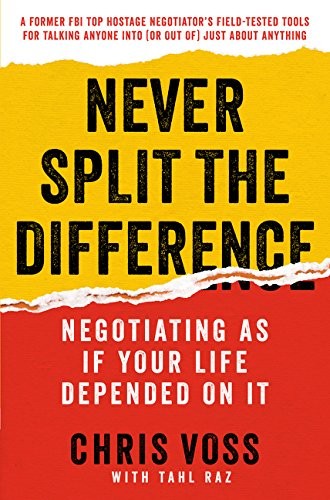
  • Cover: Never Split the Difference

    Never Split the Difference

    Book

    C. Voss & T. Raz · 2016

    The FBI's hostage-negotiation methods transposed to business and everyday life: tactical empathy, mirroring, labeling, calibrated questions. An emotional, counter-intuitive approach to persuasion.

  • Cover: Stalling for Time, My Life as an FBI Hostage Negotiator

    Stalling for Time, My Life as an FBI Hostage Negotiator

    Book

    G. Noesner · 2010

    The account of twenty-three years of crisis negotiation at the FBI by the head of its unit. A demonstration of the power of listening, patience and de-escalation in the most tense situations.

Chris Voss, "Never Split the Difference", 2016, FBI crisis negotiation.

On video

See the technique in action

Videos to picture Emotional Calibration and anchor it through examples.

A verified video selection is being enriched; the search above already surfaces the best videos on the topic.

Technique map

Where this technique sits

Every technique sits within a network: what it draws on, what it combines with, where it applies, and how to defend against it.

Levers engaged

biases & emotions

Countered by

Spot its signals, neutralise it and turn it around with the defensive playbook on this page.

See the counter-techniques

Key takeaways

  • En une phrase

    Emotional calibration is the ability to read the other party's emotional state with precision in real time, micro-expressions, tone, pace, silences, and to adjust one's own behaviour accordingly. It is the perceptual foundation of every emotional technique: without an accurate reading, a label or a mirror falls wide of the mark. It belongs to the emotional intelligencei described by Daniel Goleman.

  • The right reflex

    Use active listening in turn to gather information.

  • Never do this

    Mistaking being understood for having won your case.

8.0/10 tactical potential Moderate vigilance School grounded in research and field practice

Master this technique in real situations?

Our programmes turn theory into a concrete advantage.

Explore our programmes
Call Book a call