
NEGOCOACH
264
Origin : FBI · Chris Voss

🕵️ FBI · Chris Voss

Tactical empathy

Chris Voss, "Never Split the Difference", 2016, FBI crisis negotiation.

Full detail in the “Origin & history” section below.

264

Emotion Management

Emotional intelligence Technique 264 / 360
Alexandre Baumberger

Author of the library

Alexandre Baumberger

Negotiation lecturer at KEDGE Business School

A rare threefold background serving negotiation: teaching, commercial justice and audit, backed by experience as a company director in Bordeaux.

  • Teaching, KEDGE Business School Negotiation lecturer since 2014 (12 years).
  • Commercial justice, Commercial Court Judge from 2018 to 2026: litigation, then insolvency proceedings.
  • Audit & advisory, over 20 years Tax, employment and financial audit in major firms, for large groups.
In brief

Managing emotions is the ability to identify, regulate and express appropriately one's own affective states under pressure, so that they serve the negotiation rather than sabotage it. Far from suppression, it consists in retaining access to reason when fear, anger or euphoria threaten to dictate the decision.

Reading level

At a glance

Its family profile at a glance

Effectiveness Psychologicalimpact Discretion Preparation Relationalrisk Ethics
8.0 / 10 Tactical potential

Vigilance: moderate (4.0/10) · Preparation required: 6/10

Grounding in the source school School grounded in research and field practice

Indicative profile: it situates the “Emotional intelligence” family as the FBI · Chris Voss school practises it, not this technique taken in isolation. Techniques from the same family and school therefore share the same profile. NEGOCOACH editorial rating out of 10, non-experimental · the higher the “relational risk” value, the more costly the technique is to the relationship.

NEGOCOACH assessment

How to read this rating

Tactical potential 8.0/10 (effectiveness, impact, discretion) and vigilance moderate (relational and ethical risk): two distinct readings, deliberately never merged into a single score that would reward risk. NEGOCOACH editorial rating calibrated from the “Emotional intelligence” family and the “FBI · Chris Voss” school. Each criterion is rated out of 10; click to understand what it measures.

  • Effectiveness 8/10 · Very high

    How far the technique can carry the negotiation in the intended direction when it is well executed.

  • Psychological impact 10/10 · Very high

    Strength of the effect produced on the counterpart's perceptions, emotions and decisions.

  • Discretion 6/10 · High

    How hard it is for the other party to notice the technique is being used. A high value = very discreet.

  • Preparation 6/10 · High

    The information, analysis and rehearsal required upfront to use it effectively.

  • Relational risk 3/10 · Low

    Potential cost to the relationship and to trust if the technique is spotted, refused or fails. A high value = riskier.

  • Ethics 6/10 · High

    Moral acceptability: fairness, transparency and respect for the counterpart's autonomy. A high value = more defensible.

Level of evidence

School grounded in research and field practice

The school this technique stems from combines academic work with long field practice. This indicator qualifies the school, not this technique taken in isolation.

Indicative NEGOCOACH editorial rating, for teaching purposes. For “Relational risk”, a high value signals a cost to the relationship, not a quality.

Managing Emotions in Brief


Origin & History

The concept is central to the emotional intelligence popularised by Daniel Goleman (1995), who in turn drew on the work of Salovey and Mayeri (1990). Neuroscience added the mechanism of the amygdala hijack, that emotional short-circuit which suspends the prefrontal cortex.


Definition and Principle

Managing an emotion does not mean denying it but allowing a delay between stimulus and response, long enough for the cortex to regain control over the amygdala. The levers are physiological (breathing, slowing down) and cognitive (reappraisal, naming the emotion). The stake in negotiation: never let an affective spike take an irreversible decision in your place.i


Concrete Examples of Application

Application by context

The same technique, across every negotiation settings

Context 1 / 8

Sales negotiation

A client drops a contemptuous remark about the offer. The salesperson feels anger rising; they breathe in, pause, and respond on the facts rather than on the tone. Self-mastery avoids the confrontation that would have cost the sale.

How to apply it

At the first physiological signal (heat, quickening), slow down: a breath, a sip of water, before any response to the emotional trap.

Strengths

Protects the relationship and prevents the concession or breakdown dictated by pride.

Weaknesses

Visible regulation (an overly long silence, a strained voice) can betray fragility and expose you.
Context 2 / 8

Procurement negotiation

On the buyer's side, a supplier announces a sharp increase. The buyer, irritated, refrains from storming out: they note the emotion, set it aside, and demand quantified justification. Composure preserves their bargaining power.

How to apply it

Faced with a pricing provocation, separate indignation from the decision: respond to the data, never in the heat of the moment.

Strengths

Avoids impulsive breakdowns and keeps the buyer in a position to demand concessions in return.

Weaknesses

Excessive coldness can deprive the buyer of the leverage of controlled but overt anger.

Context 3 / 8

Labour negotiation

In collective bargaining, a representative is personally attacked. Rather than retaliating, they inwardly acknowledge their anger, breathe, and refocus on the mandate. Self-control maintains their credibility across the table.

How to apply it

Distinguish the personal attack from the collective stake; do not let the ego respond in place of the mandate.

Strengths

Preserves the negotiator's moral authority and denies the opponent the escalation they seek.

Weaknesses

Remaining impassive may be read as indifference by a rank and file expecting combativeness.

Context 4 / 8

Crisis management

In the thick of a crisis, everyone panics except the negotiator, who has learned to slow their own heart rate and voice. Their calm, contagious, brings down the surrounding tension and restores a space for decision.

How to apply it

Regulate your own state first (slow breathing, measured delivery): the leader's emotional stability spreads to the group.

Strengths

Self-mastery is the first condition of any de-escalation and any reasoning in a crisis.

Weaknesses

Emotional exhaustion in the long run: continuous regulation under stress carries a high cognitive cost.

Context 5 / 8

Political negotiation

A leader is publicly provoked at a summit. They sense the anger, contain it, and respond with a studied calm that unsettles the opponent and impresses the observers. Controlled emotion becomes an asset of stance.

How to apply it

Turn visible self-control into a signal of strength; never give the other the satisfaction of seeing you crack.

Strengths

Displayed composure reinforces stature and deprives the opponent of ammunition.

Weaknesses

Control perceived as calculated or glacial can seem inhuman and undermine buy-in.

Context 6 / 8

Real-estate negotiation

A buyer smitten with a property lets their enthusiasm show, ready to outbid. Aware of their excitement, they force themselves to breathe and stick to their ceiling. Managing the euphoria saves them from overpaying.

How to apply it

Manage positive emotions too: the euphoria of falling in love makes you sign beyond reason.

Strengths

Guards against overpayment driven by excitement and maintains ceiling discipline.

Weaknesses

Curbing enthusiasm can cause hesitation and let a genuinely desired property slip away.

Context 7 / 8

Cross-cultural negotiation

A Western negotiator grows irritated at the slow pace of a partner from another culture. Understanding that their impatience is culturally situated, they regulate their frustration and adapt to the other's tempo rather than rushing them.

How to apply it

Recognise that your irritation stems from your own cultural norms; regulate it before ascribing it to the other party.

Strengths

Avoids breakdowns caused by frustration projected onto differences in codes.

Weaknesses

Possible over-adaptation: by containing your style too much, you may lose clarity and firmness.

Context 8 / 8

Family negotiation

During a tense division of an estate, a brother feels an old resentment resurface. He names it inwardly, takes a break, and returns to the table without having vented it. Regulation prevents the old conflict from contaminating the present decision.

How to apply it

Isolate the old affective charge from the current stake; a pause is worth more than a heated response you will regret.

Strengths

Preserves the family relationship over the long term and avoids the irreparable spoken word.

Weaknesses

Suppressing a legitimate emotion within the family can make it resurface more violently later.


Counter-techniques

Spot and neutralise this technique

Negotiation is also played on defence. Here is how to recognise this technique when it is used against you, and turn it around.

Detect

The signals that give it away

  • Displayed empathy that lowers your guard
  • Mirroring of your gestures and words
  • A systematic "I understand you"

Neutralise

The counters that defuse it

  • Appreciate the warmth without relaxing
  • Keep your objectives in mind
  • Distinguish being heard from being satisfied

Turn around

Turn it into an advantage

Use active listening in turn to gather information.

The trap to avoid

Mistaking being understood for having won your case.

In Short

  • Difficulty: Intermediate to advanced
  • Estimated effectiveness: Fundamental
  • Time to implement: Immediate in the moment, long to develop
  • Fields of application: Crisis negotiation, Management, Sales, Diplomacy, Labour relations
  • Synonyms: Emotional self-regulation, Self-mastery, Self-control
  • Tags: emotional intelligence, Goleman, self-regulation, amygdala hijack, composure

Strengths and Weaknesses

Managing emotions is the foundational skill of every negotiator: without it, no tactic holds under pressure. It guards against impulsive decisions, preserves credibility and makes calm contagious. Its limit: it carries a real cognitive cost, wears thin under prolonged stress, and, taken to excess, slides into a coldness that dehumanises the exchange.


When to Use This Technique

To be deployed at all times, and acutely as soon as a strong emotion (anger, fear, euphoria) threatens to dictate an irreversible decision. Not to be confused with suppression: the aim is to regulate, not to anaesthetise. A controlled but expressed emotion remains a legitimate lever.


How to Recognise and Counter This Technique

Recognise: the opponent seeks to make you lose your calm through provocations, artificial urgency or contempt. Neutralise: allow a delay (a pause, a breath, "let me come back to that") and respond on the facts, never on the tone. Turn it around: your visible calm in the face of their provocation unsettles them and exposes them in turn.


Limits and Ethics

Managing emotions becomes problematic when it serves to mask cold manipulation or to suppress legitimate emotions that ought to be expressed. Self-control instrumentalised to intimidate or conceal is ethically questionable. Healthy regulation aims at clarity, not anaesthesia or a facade.


Variants and Related Techniques

Combines with Emotional recentring (returning to oneself) and cognitive Reframing. Complementary to Tactical empathy, which manages the other party's emotion. Stands opposed to impulsive reactivity and affective laxity.


Going Further

  • Daniel Goleman, Emotional Intelligence: Why It Can Matter More Than IQ, 1995.
  • Peter Salovey & John Mayer, "Emotional Intelligence", Imagination, Cognition and Personality, 1990.
  • Roger Fisher & Daniel Shapiro, Beyond Reason: Using Emotions as You Negotiate, 2005.

Objectives of the Technique

  • Preserve decision-making clarity under pressure and avoid concessions or breakdowns dictated by anger, fear or euphoria
  • Decode the other party's emotions as a source of information about their priorities, their limits and their walk-away point
  • Defuse emotional escalations (acknowledgement, reformulation, pause) to keep the dialogue open
  • Build a relational climate that fosters cooperation and reciprocal concessions
  • Use controlled emotional expression as a strategic signal, without lapsing into crude manipulation

Famous Cases

Diplomatic · Camp David 1978: Jimmy Carter's autographed photographs: On the thirteenth day of the Camp David summit (September 1978), Menachem Begin, exasperated, was preparing to walk out of the negotiations with Egypt. Jimmy Carter, rather than arguing on substance, brought him photographs of the summit individually autographed to the first names of each of Begin's grandchildren. Begin, moved to tears, spoke of these children's future and agreed to resume the talks, which would lead to the Camp David Accords. Carter reasoned in terms of emotions (legacy, family) where rational arguments had failed, an episode documented in Carter's memoirs and analysed by Fisher and Shapiro.

Commercial · Representative scenario: the client furious over a delivery delay: Representative scenario: a procurement director summons their supplier after a third delivery delay and opens the meeting with vehement reproaches, threatening to terminate the contract. The salesperson resists the urge to justify themselves immediately: they let the anger express itself, explicitly acknowledge it ("You feel that we are not taking your production seriously, and I understand why"), then suggest a break before turning to solutions. The tension subsides, the client shifts from the emotional register to the register of the problem to be solved, and the relationship is preserved. By responding to anger with acknowledgement rather than justification or counter-attack, the salesperson turns a confrontation into joint resolution.


Common Mistakes

  • Denying or repressing one's emotions in the name of "pure rationality": an untreated emotion resurfaces as rigidity, sarcasm or an impulsive decision
  • Telling an angry counterpart to "calm down": the injunction invalidates their emotion and almost always worsens the escalation
  • Confusing managing emotions with the absence of emotions: total coldness is perceived as contempt and destroys trust
  • Responding to emotional aggression with symmetry (anger for anger): escalation causes the interests at stake to be lost from sight
  • Faking emotions crudely (false indignation, simulated enthusiasm): a detected incongruence lastingly ruins credibility

Scientific Foundations

  • Roger Fisher, Daniel Shapiro (2005) Beyond Reason: Using Emotions as You Negotiate Viking / Penguin Books
  • Gerben A. van Kleef, Carsten K. W. De Dreu, Antony S. R. Manstead (2004) The Interpersonal Effects of Anger and Happiness in Negotiations Journal of Personality and Social Psychology, 86(1), 57-76, DOI: 10.1037/0022-3514.86.1.57
  • Chris Voss, Tahl Raz (2016) Never Split the Difference: Negotiating As If Your Life Depended On It Harper Business

Quick exercise

Test yourself before answering

Answer in your head, then reveal the solution. Memory is built through active recall.

1 Quels signaux doivent vous alerter ?
  • Displayed empathy that lowers your guard
  • Mirroring of your gestures and words
  • A systematic "I understand you"
2 Quelles parades appliquer ?
  • Appreciate the warmth without relaxing
  • Keep your objectives in mind
  • Distinguish being heard from being satisfied

Frequently asked questions

The questions we get most

What is the "Emotion Management" technique?

Managing emotions is the ability to identify, regulate and express appropriately one's own affective states under pressure, so that they serve the negotiation rather than sabotage it. Far from suppression, it consists in retaining access to reason when fear, anger or euphoria threaten to dictate the decision.

Is the "Emotion Management" technique ethical?

It sits on the line: effective, but it can tip into manipulation if it exploits an information asymmetry. Use it with measure and without deliberate deceit.

How do you defend against "Emotion Management"?

Mistaking being understood for having won your case. The right reflex: appreciate the warmth without relaxing.

What is the "Emotion Management" technique based on?

NEGOCOACH does not assess the experimental validation of this technique in isolation. What we document is the grounding of its source school (FBI · Chris Voss): school grounded in research and field practice. Full detail is in the "At a glance" section of this page.

Practise with AI

Three ready-to-use prompts

Copy, paste into your assistant, replace the [brackets]. Works with ChatGPT, Claude, Gemini, Mistral, Perplexity.

Prepare

Build your plan before the meeting

You are an expert negotiation coach. Help me prepare to use the "Emotion Management" technique in the following situation: [describe your situation]. Give me: the conditions for success, a 3-step script, my counterpart's likely objections and how to answer them.

Simulate

Rehearse against an AI counterpart

Play the role of my counterpart in a negotiation. I am going to test the "Emotion Management" technique. React realistically and with resistance, do not give in too quickly, then at the end analyse my performance and suggest 3 concrete improvements.

Debrief

Analyse a past negotiation

Here is how my negotiation went: [paste the exchanges]. Analyse whether the "Emotion Management" technique was used well, what worked, the mistakes made, and spell out precisely what I could have done better.

References

Bibliography & credible sources

Founding works of the 🕵️ FBI · Chris Voss school this technique belongs to.

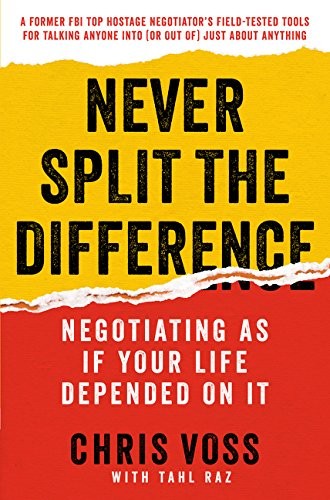
  • Cover: Never Split the Difference

    Never Split the Difference

    Book

    C. Voss & T. Raz · 2016

    The FBI's hostage-negotiation methods transposed to business and everyday life: tactical empathy, mirroring, labeling, calibrated questions. An emotional, counter-intuitive approach to persuasion.

  • Cover: Stalling for Time, My Life as an FBI Hostage Negotiator

    Stalling for Time, My Life as an FBI Hostage Negotiator

    Book

    G. Noesner · 2010

    The account of twenty-three years of crisis negotiation at the FBI by the head of its unit. A demonstration of the power of listening, patience and de-escalation in the most tense situations.

Chris Voss, "Never Split the Difference", 2016, FBI crisis negotiation.

On video

See the technique in action

Videos to picture Emotion Management and anchor it through examples.

A verified video selection is being enriched; the search above already surfaces the best videos on the topic.

Technique map

Where this technique sits

Every technique sits within a network: what it draws on, what it combines with, where it applies, and how to defend against it.

Levers engaged

biases & emotions

Countered by

Spot its signals, neutralise it and turn it around with the defensive playbook on this page.

See the counter-techniques

Key takeaways

  • En une phrase

    Managing emotions is the ability to identify, regulate and express appropriately one's own affective states under pressure, so that they serve the negotiation rather than sabotage it. Far from suppression, it consists in retaining access to reason when fear, anger or euphoria threaten to dictate the decision.

  • The right reflex

    Use active listening in turn to gather information.

  • Never do this

    Mistaking being understood for having won your case.

8.0/10 tactical potential Moderate vigilance School grounded in research and field practice

Master this technique in real situations?

Our programmes turn theory into a concrete advantage.

Explore our programmes
Call Book a call