NEGOCOACH
259
Origin : FBI · Chris Voss

🕵️ FBI · Chris Voss

Tactical empathy

Chris Voss, "Never Split the Difference", 2016, FBI crisis negotiation.

Full detail in the “Origin & history” section below.

259

Verbal Mirroring

Emotional intelligence Technique 259 / 360
Alexandre Baumberger

Author of the library

Alexandre Baumberger

Negotiation lecturer at KEDGE Business School

A rare threefold background serving negotiation: teaching, commercial justice and audit, backed by experience as a company director in Bordeaux.

  • Teaching, KEDGE Business School Negotiation lecturer since 2014 (12 years).
  • Commercial justice, Commercial Court Judge from 2018 to 2026: litigation, then insolvency proceedings.
  • Audit & advisory, over 20 years Tax, employment and financial audit in major firms, for large groups.
In brief

Verbal mirroring consists in repeating the last one to three words spoken by your counterpart, in a slightly questioning tone, to prompt them to elaborate. Popularised by Chris Vossi, it is distinct from bodily mimicry (posture, gestures): here, the tool is purely linguistic and aims to get the other party talking almost effortlessly.

Reading level

At a glance

Its family profile at a glance

Effectiveness Psychologicalimpact Discretion Preparation Relationalrisk Ethics
8.0 / 10 Tactical potential

Vigilance: moderate (4.0/10) · Preparation required: 6/10

Grounding in the source school School grounded in research and field practice

Indicative profile: it situates the “Emotional intelligence” family as the FBI · Chris Voss school practises it, not this technique taken in isolation. Techniques from the same family and school therefore share the same profile. NEGOCOACH editorial rating out of 10, non-experimental · the higher the “relational risk” value, the more costly the technique is to the relationship.

NEGOCOACH assessment

How to read this rating

Tactical potential 8.0/10 (effectiveness, impact, discretion) and vigilance moderate (relational and ethical risk): two distinct readings, deliberately never merged into a single score that would reward risk. NEGOCOACH editorial rating calibrated from the “Emotional intelligence” family and the “FBI · Chris Voss” school. Each criterion is rated out of 10; click to understand what it measures.

  • Effectiveness 8/10 · Very high

    How far the technique can carry the negotiation in the intended direction when it is well executed.

  • Psychological impact 10/10 · Very high

    Strength of the effect produced on the counterpart's perceptions, emotions and decisions.

  • Discretion 6/10 · High

    How hard it is for the other party to notice the technique is being used. A high value = very discreet.

  • Preparation 6/10 · High

    The information, analysis and rehearsal required upfront to use it effectively.

  • Relational risk 3/10 · Low

    Potential cost to the relationship and to trust if the technique is spotted, refused or fails. A high value = riskier.

  • Ethics 6/10 · High

    Moral acceptability: fairness, transparency and respect for the counterpart's autonomy. A high value = more defensible.

Level of evidence

School grounded in research and field practice

The school this technique stems from combines academic work with long field practice. This indicator qualifies the school, not this technique taken in isolation.

Indicative NEGOCOACH editorial rating, for teaching purposes. For “Relational risk”, a high value signals a cost to the relationship, not a quality.

Summary of Verbal Mirroring


Origin & history

Verbal mirroring was formalised by Chris Voss in Never Split the Difference (2016) as one of his active-listening tools drawn from FBI hostage negotiation. It differs from the bodily mirroring studied in social psychology (the chameleon effect of Chartrand and Barghi, 1999), which concerns posture rather than words.


Definition and principle

Verbal mirroring echoes back, as a questioning prompt, the last key words of the other party's sentence, then holds a silence. This simple reflection creates a sense of being listened to and pushes the counterpart to clarify, justify, say more, often beyond what they intended to reveal. It is the most economical tool in the toolkit: three words suffice, provided you calibrate it so as not to appear to be aping the other party.


Concrete examples of application

Application by context

The same technique, across every negotiation settings

Context 1 / 8

Sales negotiation

A client says: 'Your solution is too cumbersome to deploy.' The salesperson simply replies: 'Too cumbersome to deploy?' The client, invited to clarify, spells out their real concern: they fear the burden on their already overstretched IT team.

How to apply it

Echo back the last two or three emotionally charged words, rising tone, then silence; the other party digs in of their own accord.

Strengths

Surfaces the concrete objection without confrontation; the client feels listened to.

Weaknesses

Repeated too often, the echo becomes noticeable and gives the impression of a parrot or an evasion.
Context 2 / 8

Procurement negotiation

A salesperson asserts: 'That's our best price, I can't go any lower.' The buyer calmly repeats: 'You can't go any lower?' The silence that follows pushes the seller to qualify their stance and mention a possible volume discount.

How to apply it

Mirror the seller's assertion of firmness; the reflection often leads them to soften their own limit.

Strengths

Shifts a position presented as non-negotiable, without raising your voice or arguing.

Weaknesses

A trained seller recognises the technique and may respond with an equal silence, neutralising the effect.

Context 3 / 8

Labour negotiation

An employee blurts out: 'Anyway, my opinion never counts here.' The manager reflects: 'Never counts?' The invitation to elaborate draws out a specific feeling of exclusion, on which it becomes possible to act.

How to apply it

Mirror the strong emotional phrase ('never', 'always') to make them clarify a grievance often exaggerated in the heat of the moment.

Strengths

Turns a vague complaint into a discussable fact; defuses without contradicting.

Weaknesses

In a poorly judged tone, the mirror can seem ironic and reignite the tension.

Context 4 / 8

Crisis management

Facing someone who threatens to call everything off, the negotiator repeats their last words ('call everything off?') calmly and without judgement, keeping the thread of conversation open long enough for the emotion to subside.

How to apply it

Use the mirror to keep the channel open without introducing any new idea; the other party keeps talking, which defuses the impulsive act.

Strengths

Sustains the dialogue when any direct question would be experienced as pressure.

Weaknesses

At very high intensity, a poorly placed echo can be heard as mockery.

Context 5 / 8

Political negotiation

An opposing negotiator sets a demand: 'We want written guarantees, or nothing.' The facilitator repeats: 'Written guarantees?', leading the other party to specify which ones, reducing a matter-of-principle demand to a concrete, workable request.

How to apply it

Mirror the ultimatum to make it break down into specific requests, easier to satisfy in part.

Strengths

Converts a blocking stance into a list of negotiable items.

Weaknesses

May be perceived as a delaying tactic if the other party expects a firm, immediate answer.

Context 6 / 8

Real-estate negotiation

A seller declares: 'Below that price, it's not even worth discussing.' The agent reflects: 'Not worth discussing?' The seller, invited to explain, reveals that they actually have a lower floor figure, tied to a specific plan.

How to apply it

Mirror the stated red line; the reflection often reveals the real numerical constraint behind the posture.

Strengths

Uncovers the seller's true floor without negotiating head-on.

Weaknesses

Ineffective against a terse seller who merely confirms without elaborating.

Context 7 / 8

Cross-cultural negotiation

With a counterpart whose language is not your own, verbal mirroring also serves to check comprehension: echoing their last words confirms the meaning while inviting them to clarify. The echoing gesture is well received in most cultures, more neutral than an emotional label.

How to apply it

Use the mirror as a reformulation tool with low cultural risk; it shows listening without naming an intimate feeling.

Strengths

Reduces linguistic misunderstandings and works in almost every cultural context.

Weaknesses

An overly literal echo of a foreign language can seem like a correction or a taunt.

Context 8 / 8

Family negotiation

A loved one says, irritated: 'You never listen to me when it matters.' Replying 'When it matters?' rather than defending yourself opens up the explanation and makes them specify the situation in question, instead of triggering a defensive quarrel.

How to apply it

Mirror rather than justify: where self-defence inflames, the echo invites the other party to spell out the real grievance.

Strengths

Avoids the defensive spiral and brings out the heart of the reproach.

Weaknesses

In an intimate context, a systematic echo is quickly perceived as an evasion or a provocation.


Counter-techniques

Spot and neutralise this technique

Negotiation is also played on defence. Here is how to recognise this technique when it is used against you, and turn it around.

Detect

The signals that give it away

  • Displayed empathy that lowers your guard
  • Mirroring of your gestures and words
  • A systematic "I understand you"

Neutralise

The counters that defuse it

  • Appreciate the warmth without relaxing
  • Keep your objectives in mind
  • Distinguish being heard from being satisfied

Turn around

Turn it into an advantage

Use active listening in turn to gather information.

The trap to avoid

Mistaking being understood for having won your case.

In brief

  • Difficulty: Accessible
  • Estimated effectiveness: High
  • Time to implement: Immediate
  • Fields of application: Sales, Crisis negotiation, Interview, Management, Mediation
  • Synonyms: Verbal echo, Voss mirroring, Reflecting the last words
  • Tags: mirroring, echo, Chris Voss, active listening, silence

Strengths and Weaknesses

Verbal mirroring is the tool with the best effort-to-effect ratio: three repeated words make the other party talk, reveal information and create a sense of being heard, without conceding anything. Its weakness: excessive repetition makes it visible and gives the impression of a parrot or an evasion, which erodes credibility.


When to use this technique?

Use it to get the other party talking, to make them clarify an objection or break down an ultimatum, and to sustain the dialogue under tension. Calibrate it: one mirror every few exchanges, not on every sentence. Avoid it when the other party expects a firm, immediate answer, where the echo appears evasive.


How to recognise and counter this technique

Recognise it: the other party systematically repeats your last words, rising tone, then falls silent to make you talk. Neutralise it: answer briefly and hand back the silence ('Yes. Over to you.') instead of filling the void. Turn it around: apply the mirror to their own strong phrases to regain the initiative in the exchange.


Limits and ethics

Mirroring remains an information-extraction technique: using it to make someone talk beyond what they consent to reveal, or to wear them down through silence, amounts to manipulation. In an interview involving vulnerability, it must be accompanied by transparency about the intention. Done well, it serves mutual understanding, not entrapment.


Variants and related techniques

It combines closely with Labeling and silence in the Voss method (the three make up tactical listening). Not to be confused with bodily mirroring (imitation of posture, the chameleon effect), its non-verbal counterpart. Close to echo reformulation and to the non-directive prompting of the interview.


To go further

  • Chris Voss & Tahl Raz, Never Split the Difference, chapter on mirroring, 2016.
  • Tanya Chartrand & John Bargh, 'The Chameleon Effect: The Perception-Behavior Link and Social Interaction', Journal of Personality and Social Psychology, 1999.
  • Robert Cialdini, Influence: The Psychology of Persuasion, chapter on liking and similarity, 1984.

Objectives of the technique

  • Prompt the counterpart to develop and clarify their thinking without asking a direct question or applying pressure
  • Gather information the other party had not intended to reveal (real constraints, true floor, hidden motives)
  • Create a sense of being listened to and connected that lowers wariness and keeps the dialogue open
  • Break down a firm position or an ultimatum into concrete, negotiable requests
  • Buy thinking time without conceding, contradicting or committing

Famous cases

Judicial - The Chase Manhattan Bank robbery (Brooklyn, 1993): A case documented by Chris Voss himself in 'Never Split the Difference' (2016). During the hostage-taking at the Chase Manhattan Bank in Brooklyn, the NYPD and then FBI negotiators, Voss among them, systematically use verbal mirroring with hostage-taker Chris Watts: they repeat his last words in a calm, questioning tone, then let the silence work. Pushed to talk in order to fill the void, Watts piles up inconsistencies and lets slip decisive information, notably the existence of accomplices and a getaway vehicle, which direct questions would never have obtained. The crisis is resolved without bloodshed, and Voss would make this episode the founding case of his active-listening method.

Everyday life - The Dutch waitresses study: repeating the order increases tips: A real field experiment conducted by Rick van Baaren and colleagues (University of Nijmegen, 2003). In a restaurant, a waitress repeats word for word the order of one half of the customers, and merely says a neutral 'very good' to the other half. Measured result: the customers whose words were repeated leave significantly higher tips; the verbal echo raises the average amount by roughly 70% in this study. Simply repeating the other party's words creates a sense of being heard that translates into concrete, measurable behaviour. It is one of the rare direct experimental validations of verbal mirroring.


Common mistakes

  • Paraphrasing the whole sentence instead of echoing one to three words: the mirror becomes a heavy reformulation, even a noticeable parroting effect
  • Immediately following up with an argument or a question: it is the silence after the echo that makes the other party talk, not the echo alone
  • Using a falling, flat or heavy-handed tone: the echo is then perceived as irony or mockery and reignites the tension
  • Overusing the technique on every exchange: repeated on a loop, it becomes visible, passes for an evasion and destroys trust
  • Reflecting innocuous words rather than charged ones (emotion, ultimatum, figure, 'never/always'): the invitation to dig deeper falls wide of the useful information

Scientific foundations

  • Chris Voss & Tahl Raz (2016) Never Split the Difference: Negotiating As If Your Life Depended On It HarperBusiness
  • Rick B. van Baaren, Rob W. Holland, Bregje Steenaert & Ad van Knippenberg (2003) Mimicry for money: Behavioral consequences of imitation Journal of Experimental Social Psychology, 39(4), 393-398, DOI: 10.1016/S0022-1031(03)00014-3
  • William W. Maddux, Elizabeth Mullen & Adam D. Galinsky (2008) Chameleons bake bigger pies and take bigger pieces: Strategic behavioral mimicry facilitates negotiation outcomes Journal of Experimental Social Psychology, 44(2), 461-468

Quick exercise

Test yourself before answering

Answer in your head, then reveal the solution. Memory is built through active recall.

1 Quels signaux doivent vous alerter ?
  • Displayed empathy that lowers your guard
  • Mirroring of your gestures and words
  • A systematic "I understand you"
2 Quelles parades appliquer ?
  • Appreciate the warmth without relaxing
  • Keep your objectives in mind
  • Distinguish being heard from being satisfied

Frequently asked questions

The questions we get most

What is the "Verbal Mirroring" technique?

Verbal mirroring consists in repeating the last one to three words spoken by your counterpart, in a slightly questioning tone, to prompt them to elaborate. Popularised by Chris Vossi, it is distinct from bodily mimicry (posture, gestures): here, the tool is purely linguistic and aims to get the other party talking almost effortlessly.

Is the "Verbal Mirroring" technique ethical?

It sits on the line: effective, but it can tip into manipulation if it exploits an information asymmetry. Use it with measure and without deliberate deceit.

How do you defend against "Verbal Mirroring"?

Mistaking being understood for having won your case. The right reflex: appreciate the warmth without relaxing.

What is the "Verbal Mirroring" technique based on?

NEGOCOACH does not assess the experimental validation of this technique in isolation. What we document is the grounding of its source school (FBI · Chris Voss): school grounded in research and field practice. Full detail is in the "At a glance" section of this page.

Practise with AI

Three ready-to-use prompts

Copy, paste into your assistant, replace the [brackets]. Works with ChatGPT, Claude, Gemini, Mistral, Perplexity.

Prepare

Build your plan before the meeting

You are an expert negotiation coach. Help me prepare to use the "Verbal Mirroring" technique in the following situation: [describe your situation]. Give me: the conditions for success, a 3-step script, my counterpart's likely objections and how to answer them.

Simulate

Rehearse against an AI counterpart

Play the role of my counterpart in a negotiation. I am going to test the "Verbal Mirroring" technique. React realistically and with resistance, do not give in too quickly, then at the end analyse my performance and suggest 3 concrete improvements.

Debrief

Analyse a past negotiation

Here is how my negotiation went: [paste the exchanges]. Analyse whether the "Verbal Mirroring" technique was used well, what worked, the mistakes made, and spell out precisely what I could have done better.

References

Bibliography & credible sources

Founding works of the 🕵️ FBI · Chris Voss school this technique belongs to.

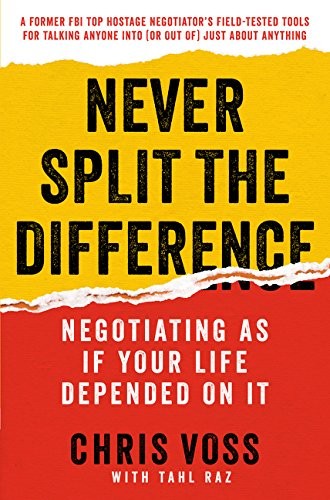
  • Cover: Never Split the Difference

    Never Split the Difference

    Book

    C. Voss & T. Raz · 2016

    The FBI's hostage-negotiation methods transposed to business and everyday life: tactical empathy, mirroring, labeling, calibrated questions. An emotional, counter-intuitive approach to persuasion.

  • Cover: Stalling for Time, My Life as an FBI Hostage Negotiator

    Stalling for Time, My Life as an FBI Hostage Negotiator

    Book

    G. Noesner · 2010

    The account of twenty-three years of crisis negotiation at the FBI by the head of its unit. A demonstration of the power of listening, patience and de-escalation in the most tense situations.

Chris Voss, "Never Split the Difference", 2016, FBI crisis negotiation.

On video

See the technique in action

Videos to picture Verbal Mirroring and anchor it through examples.

A verified video selection is being enriched; the search above already surfaces the best videos on the topic.

Technique map

Where this technique sits

Every technique sits within a network: what it draws on, what it combines with, where it applies, and how to defend against it.

Levers engaged

biases & emotions

Countered by

Spot its signals, neutralise it and turn it around with the defensive playbook on this page.

See the counter-techniques

Key takeaways

  • En une phrase

    Verbal mirroring consists in repeating the last one to three words spoken by your counterpart, in a slightly questioning tone, to prompt them to elaborate. Popularised by Chris Vossi, it is distinct from bodily mimicry (posture, gestures): here, the tool is purely linguistic and aims to get the other party talking almost effortlessly.

  • The right reflex

    Use active listening in turn to gather information.

  • Never do this

    Mistaking being understood for having won your case.

8.0/10 tactical potential Moderate vigilance School grounded in research and field practice

Master this technique in real situations?

Our programmes turn theory into a concrete advantage.

Explore our programmes
Call Book a call