
NEGOCOACH
263
Origin : FBI · Chris Voss

🕵️ FBI · Chris Voss

Tactical empathy

Chris Voss, "Never Split the Difference", 2016, FBI crisis negotiation.

Full detail in the “Origin & history” section below.

263

The Pattern Interrupt

Emotional intelligence Technique 263 / 360
Alexandre Baumberger

Author of the library

Alexandre Baumberger

Negotiation lecturer at KEDGE Business School

A rare threefold background serving negotiation: teaching, commercial justice and audit, backed by experience as a company director in Bordeaux.

  • Teaching, KEDGE Business School Negotiation lecturer since 2014 (12 years).
  • Commercial justice, Commercial Court Judge from 2018 to 2026: litigation, then insolvency proceedings.
  • Audit & advisory, over 20 years Tax, employment and financial audit in major firms, for large groups.
In brief

The pattern interrupt consists in abruptly breaking an automatic sequence (mental, verbal or behavioural) in your counterpart to pull them out of unconscious autopilot and reopen a window of receptivity. An unexpected word, a silence, an incongruous gesture is enough to destabilise the script they were running, creating a moment of suspension ripe for a fresh proposal.

Reading level

At a glance

Its family profile at a glance

Effectiveness Psychologicalimpact Discretion Preparation Relationalrisk Ethics
8.0 / 10 Tactical potential

Vigilance: moderate (4.0/10) · Preparation required: 6/10

Grounding in the source school School grounded in research and field practice

Indicative profile: it situates the “Emotional intelligence” family as the FBI · Chris Voss school practises it, not this technique taken in isolation. Techniques from the same family and school therefore share the same profile. NEGOCOACH editorial rating out of 10, non-experimental · the higher the “relational risk” value, the more costly the technique is to the relationship.

NEGOCOACH assessment

How to read this rating

Tactical potential 8.0/10 (effectiveness, impact, discretion) and vigilance moderate (relational and ethical risk): two distinct readings, deliberately never merged into a single score that would reward risk. NEGOCOACH editorial rating calibrated from the “Emotional intelligence” family and the “FBI · Chris Voss” school. Each criterion is rated out of 10; click to understand what it measures.

  • Effectiveness 8/10 · Very high

    How far the technique can carry the negotiation in the intended direction when it is well executed.

  • Psychological impact 10/10 · Very high

    Strength of the effect produced on the counterpart's perceptions, emotions and decisions.

  • Discretion 6/10 · High

    How hard it is for the other party to notice the technique is being used. A high value = very discreet.

  • Preparation 6/10 · High

    The information, analysis and rehearsal required upfront to use it effectively.

  • Relational risk 3/10 · Low

    Potential cost to the relationship and to trust if the technique is spotted, refused or fails. A high value = riskier.

  • Ethics 6/10 · High

    Moral acceptability: fairness, transparency and respect for the counterpart's autonomy. A high value = more defensible.

Level of evidence

School grounded in research and field practice

The school this technique stems from combines academic work with long field practice. This indicator qualifies the school, not this technique taken in isolation.

Indicative NEGOCOACH editorial rating, for teaching purposes. For “Relational risk”, a high value signals a cost to the relationship, not a quality.

The Pattern Interrupt in brief


Origin & history

The concept was formalised by Richard Bandler and John Grinderi, the founders of NLP, from the induction techniques of Milton Erickson. It ties in with work in cognitive psychology on the automaticity of behaviour and the breaking of habit.


Definition and principle

A pattern is an automated sequence (the stock objection, the handshake, the refusal phrase). Interrupting it creates a momentary void in which the brain, deprived of its script, becomes suggestible and looks for a new direction. The point is not surprise for its own sake, but the window of receptivity it opens immediately afterwards.i


Concrete examples of application

Application by context

The same technique, across every negotiation settings

Context 1 / 8

Sales negotiation

A prospect runs through their ritual objection: "We'll think it over and get back to you." The salesperson breaks the script: "Of course. Just one question: honestly, what would make you say no?" The jolt halts the polite retreat and reopens a genuine exchange.

How to apply it

Spot the automatic escape phrase and break it with an unexpected or candid question, never with a standard sales follow-up.

Strengths

Unblocks meeting endings that bog down in evasive politeness.

Weaknesses

An interrupt that is too brutal or theatrical reads as manipulation and puts the buyer on the defensive.
Context 2 / 8

Procurement negotiation

On the buyer's side, a salesperson reels off their rote pitch. The buyer cuts in: "Hold on two seconds, forget the presentation, just tell me why you rather than someone else." Knocked out of their script, the seller reveals a sincere, usable argument.

How to apply it

Cut off the automatic pitch to force an unrehearsed remark, often more revealing of the real margins.

Strengths

Pulls the seller out of their rehearsed posture and brings out unscripted information.

Weaknesses

May be experienced as a lack of respect and chill a budding partnership.

Context 3 / 8

Labour negotiation

In a meeting, a debate goes round in circles over the same grievances. The facilitator breaks the cycle: "Let's stop for a minute. If we had already solved this, what would this meeting look like?" The change of frame halts the conflict loop.

How to apply it

Interrupt the loop of recrimination with a temporal reframe or a projective question that redirects attention.

Strengths

Breaks sterile spirals and redirects the group's energy towards the solution.

Weaknesses

If the interruption is perceived as a denial of the grievance, it stokes frustration.

Context 4 / 8

Crisis management

Faced with someone repeatedly escalating verbally, the negotiator suddenly lowers their voice and slows down: "Wait... just repeat the first thing you said to me." The break in rhythm cuts off the automatic emotional build-up.

How to apply it

Break the rhythm of escalation with a change of tempo or volume, not with an argument that would feed the spiral.

Strengths

Interrupts the emotional runaway precisely where any contradiction would only inflame it.

Weaknesses

Poorly judged, the interrupt can be read as provocation or contempt and worsen the crisis.

Context 5 / 8

Political negotiation

In a negotiation frozen on declaimed positions, a mediator breaks the ritual: "Let's suspend the official postures for five minutes: what is it that none of you can do without?" The jolt takes the parties out of their set-piece rhetoric.

How to apply it

Interrupt the recitation of positions with an invitation to speak to real interests, off-camera where possible.

Strengths

Unlocks tables paralysed by grandstanding.

Weaknesses

Sensitive ground: a clumsy interrupt can be exploited as a breach of protocol.

Context 6 / 8

Real-estate negotiation

A buyer recites their usual price-cut arguments. The agent breaks in: "Let me stop you: what if price weren't the issue? What would make you sign today?" The offbeat question reveals the real sticking point (financing, timing).

How to apply it

Break the reflex haggling with a question that shifts the issue from price to the real blocker.

Strengths

Brings out the hidden sticking point behind mechanical price bargaining.

Weaknesses

No effect on a buyer whose only sticking point really is the asking price.

Context 7 / 8

Cross-cultural negotiation

Between two teams locked into misunderstandings of style (one too direct, the other too allusive), the facilitator breaks in: "Let's set aside our habits for two minutes: each of you tell me what you thought you understood about the other." The jolt clears up the cultural misunderstanding.

How to apply it

Interrupt the automatic cultural projection with a cross-explicitation of each side's interpretations.

Strengths

Reveals mismatches of codes before they block the agreement.

Weaknesses

A break judged too head-on offends cultures with a strong regard for face.

Context 8 / 8

Family negotiation

A family quarrel has repeated the same reproaches for years. One person breaks the scenario: "We've had this argument a hundred times. What if, for once, you told me what you really expect from me?" The unexpected line breaks the ritual of conflict.

How to apply it

Interrupt the family conflict script with a sincere, disarmed request, free of reproach.

Strengths

Opens a breach in deeply entrenched relational patterns.

Weaknesses

If the break seems calculated, it is perceived as evasion and reinforces distrust.


Counter-techniques

Spot and neutralise this technique

Negotiation is also played on defence. Here is how to recognise this technique when it is used against you, and turn it around.

Detect

The signals that give it away

  • Displayed empathy that lowers your guard
  • Mirroring of your gestures and words
  • A systematic "I understand you"

Neutralise

The counters that defuse it

  • Appreciate the warmth without relaxing
  • Keep your objectives in mind
  • Distinguish being heard from being satisfied

Turn around

Turn it into an advantage

Use active listening in turn to gather information.

The trap to avoid

Mistaking being understood for having won your case.

In brief

  • Difficulty: Advanced
  • Estimated effectiveness: High but situational
  • Time to implement: Instant, requires good timing
  • Fields of application: Sales, Crisis negotiation, Facilitation, Coaching, Communication
  • Synonyms: Pattern interruption, Schema break, Break state
  • Tags: NLP, Bandler, Erickson, break, reframing

Strengths and weaknesses

The pattern interrupt reopens attention where the exchange had gone onto autopilot: it halts loops, ritual objections and escalations, and creates a window of receptivity. Instant and low-cost, it concedes nothing. Its limitation: it depends on precise timing and, poorly executed, it reads as manipulation or disrespect.


When to use this technique

Use it when the other party is running an automatic script (stock objection, escalation, sterile loop) that is blocking the exchange. Avoid it as a mere flashy stunt: without a constructive intention behind it, the effect backfires. Pointless in a discussion that is already fluid and open.


How to recognise and counter this technique

Recognise it: your counterpart cuts you off with offbeat phrases or gestures at the precise moment you were about to close or refuse. Neutralise it: name the manoeuvre calmly ("Nice move, but my answer stays the same") and pick up your thread. Turn it around: welcome the unexpected question and then send it back ("Good question, and you, what do you think?").


Limitations and ethics

The pattern interrupt verges on cognitive manipulation when it exploits the suggestibility created by the break to push through a proposal the other party would not have accepted with a clear head. Its use on vulnerable people or those in a state of shock is ethically questionable. The rule: open a space of clarity, not exploit it to short-circuit consent.


Variants and related techniques

Combines with Reframing (giving a new meaning) and Silence. Close to Emotional recentring when it aims at calming things down. Opposed to repetition and head-on insistence.


Going further

  • Richard Bandler & John Grinder, Frogs into Princes: Neuro Linguistic Programming, 1979.
  • Milton H. Erickson & Ernest Rossi, Hypnotherapy: An Exploratory Casebook, 1979.
  • Robert Cialdini, Pre-Suasion: A Revolutionary Way to Influence and Persuade, 2016.

Aims of the technique

  • Break an automatic refusal or a mental script in the counterpart ("no thanks", closed posture, rote pitch) in order to reopen their attention.
  • Create a brief window of cognitive disorganisation during which a favourable reframe ("it's a good deal", a fresh proposal) is more readily accepted.
  • Break a dynamic of escalation or deadlock in the negotiation (rising tone, repetition of the same positions) by introducing an unexpected element.
  • Regain control of the discussion's frame when the other party is running a well-drilled power play.
  • Make your message memorable by setting it apart from the stereotyped approaches your counterpart has learned to filter out.

Famous cases

Sales · The "300 pennies" experiment (Davis & Knowles, 1999): A real, documented case. In a series of field experiments published in the Journal of Personality and Social Psychology, sellers went door-to-door offering greetings cards in aid of a charity. Announced conventionally at "3 dollars", they were bought by roughly 40% of the people approached. But when the seller announced "300 pennies... it's a good deal", the purchase rate doubled, to around 80%. The unusual wording (the price in pennies) interrupted the mental script of automatic refusal; the immediate reframe ("it's a good deal") slipped into that brief cognitive disorganisation. This is the founding experimental demonstration of the pattern interrupt: the break alone is not enough, it is the pairing of interruption + reframe that produces the effect.

Business · Defusing a renegotiation that has stalled (representative scenario): A representative scenario, not attributed to real people. An annual renegotiation between a manufacturer and its distributor turns into a ritual: demand for a further discount, threat of delisting, defensive response on costs, each reciting their part. At the third meeting, just as the buyer launches into their usual threat, the sales director closes her binder, holds a silence, then asks: "Before we go on, one question: what would make this year the best of our partnership, for you?" The question, entirely outside the expected script, interrupts the mechanics of confrontation. The buyer, thrown for a few seconds, answers on substance (stock rotation, out-of-stocks on the shelf). The discussion moves onto the real operational problems, and the demanded discount is replaced by a logistics agreement. The break in the pattern did not "win" the negotiation: it made another frame of discussion possible.


Common mistakes

  • Interrupting without reframing: research shows that the break alone produces nothing; without a clear message immediately afterwards (proposal, question, reorientation), you get only confusion, or even irritation.
  • Confusing pattern interrupt with provocation: a break perceived as disrespectful (mockery, an abrupt gesture, misplaced familiarity) destroys trust instead of opening up attention.
  • Overusing it: repeated, the technique itself becomes a predictable pattern; the counterpart grows used to it and decodes it as manipulation, which reinforces their distrust.
  • Using it on an analytical or well-prepared counterpart who is negotiating from a brief: the effect rests on interrupting an automatism; against deliberate, documented reasoning, it is weak or nil.
  • Miscalibrating the intensity: a break that is too faint goes unnoticed, one that is too strong (excessive theatricality) shifts attention onto the manoeuvre itself rather than the message that follows.

Scientific foundations

  • Davis, B. P. & Knowles, E. S. (1999) A disrupt-then-reframe technique of social influence Journal of Personality and Social Psychology, 76(2), 192-199, DOI: 10.1037/0022-3514.76.2.192
  • Fennis, B. M., Das, E. H. H. J. & Pruyn, A. Th. H. (2004) "If You Can't Dazzle Them with Brilliance, Baffle Them with Nonsense": Extending the Impact of the Disrupt-Then-Reframe Technique of Social Influence Journal of Consumer Psychology, 14(3), 280-290, DOI: 10.1207/s15327663jcp1403_9
  • Cialdini, R. B. (2016) Pre-Suasion: A Revolutionary Way to Influence and Persuade Simon & Schuster

Quick exercise

Test yourself before answering

Answer in your head, then reveal the solution. Memory is built through active recall.

1 Quels signaux doivent vous alerter ?
  • Displayed empathy that lowers your guard
  • Mirroring of your gestures and words
  • A systematic "I understand you"
2 Quelles parades appliquer ?
  • Appreciate the warmth without relaxing
  • Keep your objectives in mind
  • Distinguish being heard from being satisfied

Frequently asked questions

The questions we get most

What is the "The Pattern Interrupt" technique?

The pattern interrupt consists in abruptly breaking an automatic sequence (mental, verbal or behavioural) in your counterpart to pull them out of unconscious autopilot and reopen a window of receptivity. An unexpected word, a silence, an incongruous gesture is enough to destabilise the script they were running, creating a moment of suspension ripe for a fresh proposal.

Is the "The Pattern Interrupt" technique ethical?

It sits on the line: effective, but it can tip into manipulation if it exploits an information asymmetry. Use it with measure and without deliberate deceit.

How do you defend against "The Pattern Interrupt"?

Mistaking being understood for having won your case. The right reflex: appreciate the warmth without relaxing.

What is the "The Pattern Interrupt" technique based on?

NEGOCOACH does not assess the experimental validation of this technique in isolation. What we document is the grounding of its source school (FBI · Chris Voss): school grounded in research and field practice. Full detail is in the "At a glance" section of this page.

Practise with AI

Three ready-to-use prompts

Copy, paste into your assistant, replace the [brackets]. Works with ChatGPT, Claude, Gemini, Mistral, Perplexity.

Prepare

Build your plan before the meeting

You are an expert negotiation coach. Help me prepare to use the "The Pattern Interrupt" technique in the following situation: [describe your situation]. Give me: the conditions for success, a 3-step script, my counterpart's likely objections and how to answer them.

Simulate

Rehearse against an AI counterpart

Play the role of my counterpart in a negotiation. I am going to test the "The Pattern Interrupt" technique. React realistically and with resistance, do not give in too quickly, then at the end analyse my performance and suggest 3 concrete improvements.

Debrief

Analyse a past negotiation

Here is how my negotiation went: [paste the exchanges]. Analyse whether the "The Pattern Interrupt" technique was used well, what worked, the mistakes made, and spell out precisely what I could have done better.

References

Bibliography & credible sources

Founding works of the 🕵️ FBI · Chris Voss school this technique belongs to.

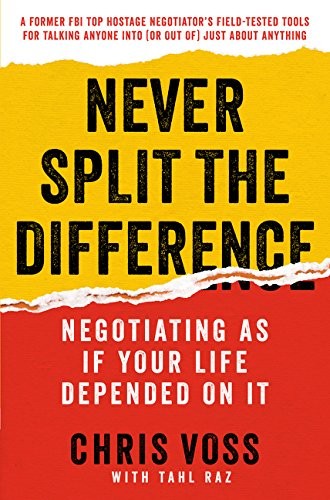
  • Cover: Never Split the Difference

    Never Split the Difference

    Book

    C. Voss & T. Raz · 2016

    The FBI's hostage-negotiation methods transposed to business and everyday life: tactical empathy, mirroring, labeling, calibrated questions. An emotional, counter-intuitive approach to persuasion.

  • Cover: Stalling for Time, My Life as an FBI Hostage Negotiator

    Stalling for Time, My Life as an FBI Hostage Negotiator

    Book

    G. Noesner · 2010

    The account of twenty-three years of crisis negotiation at the FBI by the head of its unit. A demonstration of the power of listening, patience and de-escalation in the most tense situations.

Chris Voss, "Never Split the Difference", 2016, FBI crisis negotiation.

On video

See the technique in action

Videos to picture The Pattern Interrupt and anchor it through examples.

A verified video selection is being enriched; the search above already surfaces the best videos on the topic.

Technique map

Where this technique sits

Every technique sits within a network: what it draws on, what it combines with, where it applies, and how to defend against it.

Levers engaged

biases & emotions

Countered by

Spot its signals, neutralise it and turn it around with the defensive playbook on this page.

See the counter-techniques

Key takeaways

  • En une phrase

    The pattern interrupt consists in abruptly breaking an automatic sequence (mental, verbal or behavioural) in your counterpart to pull them out of unconscious autopilot and reopen a window of receptivity. An unexpected word, a silence, an incongruous gesture is enough to destabilise the script they were running, creating a moment of suspension ripe for a fresh proposal.

  • The right reflex

    Use active listening in turn to gather information.

  • Never do this

    Mistaking being understood for having won your case.

8.0/10 tactical potential Moderate vigilance School grounded in research and field practice

Master this technique in real situations?

Our programmes turn theory into a concrete advantage.

Explore our programmes
Call Book a call