
NEGOCOACH
116
Origin : FBI · Chris Voss

🕵️ FBI · Chris Voss

Tactical empathy

Chris Voss, "Never Split the Difference", 2016, FBI crisis negotiation.

Full detail in the “Origin & history” section below.

116

The Emotional Labeling Technique

Psychological influence Technique 116 / 360
Alexandre Baumberger

Author of the library

Alexandre Baumberger

Negotiation lecturer at KEDGE Business School

A rare threefold background serving negotiation: teaching, commercial justice and audit, backed by experience as a company director in Bordeaux.

  • Teaching, KEDGE Business School Negotiation lecturer since 2014 (12 years).
  • Commercial justice, Commercial Court Judge from 2018 to 2026: litigation, then insolvency proceedings.
  • Audit & advisory, over 20 years Tax, employment and financial audit in major firms, for large groups.
In brief

Labelling consists in naming out loud the emotion you perceive in your counterpart: “it sounds like this deadline is worrying you”, “it seems that you don't feel respected”. By verbalising the emotion, you defuse it and demonstrate a deep understanding, without ever conceding the substance of the matter.

Reading level

At a glance

Its family profile at a glance

Effectiveness Psychologicalimpact Discretion Preparation Relationalrisk Ethics
8.3 / 10 Tactical potential

Vigilance: high (6.0/10) · Preparation required: 6/10

Grounding in the source school School grounded in research and field practice

Indicative profile: it situates the “Psychological influence” family as the FBI · Chris Voss school practises it, not this technique taken in isolation. Techniques from the same family and school therefore share the same profile. NEGOCOACH editorial rating out of 10, non-experimental · the higher the “relational risk” value, the more costly the technique is to the relationship.

NEGOCOACH assessment

How to read this rating

Tactical potential 8.3/10 (effectiveness, impact, discretion) and vigilance high (relational and ethical risk): two distinct readings, deliberately never merged into a single score that would reward risk. NEGOCOACH editorial rating calibrated from the “Psychological influence” family and the “FBI · Chris Voss” school. Each criterion is rated out of 10; click to understand what it measures.

  • Effectiveness 8/10 · Very high

    How far the technique can carry the negotiation in the intended direction when it is well executed.

  • Psychological impact 10/10 · Very high

    Strength of the effect produced on the counterpart's perceptions, emotions and decisions.

  • Discretion 7/10 · High

    How hard it is for the other party to notice the technique is being used. A high value = very discreet.

  • Preparation 6/10 · High

    The information, analysis and rehearsal required upfront to use it effectively.

  • Relational risk 5/10 · Moderate

    Potential cost to the relationship and to trust if the technique is spotted, refused or fails. A high value = riskier.

  • Ethics 4/10 · Moderate

    Moral acceptability: fairness, transparency and respect for the counterpart's autonomy. A high value = more defensible.

Level of evidence

School grounded in research and field practice

The school this technique stems from combines academic work with long field practice. This indicator qualifies the school, not this technique taken in isolation.

Indicative NEGOCOACH editorial rating, for teaching purposes. For “Relational risk”, a high value signals a cost to the relationship, not a quality.

Overview of EMOTIONAL LABELLING


Origin & history

Labelling draws on a discovery from affective neuroscience: in 2007, the researcher Matthew Lieberman (UCLA) demonstrated through fMRI that putting an emotion into words, “affect labelling”, reduces the activity of the amygdala, the brain's fear centre. Naming an emotion literally soothes it. The FBI's crisis negotiators, and later Chris Voss, transposed this mechanism to the negotiating table: whereas one used to try to ignore the opponent's emotions, one now learns instead to name them in order to neutralise them. The technique marks the shift from a “rational” negotiation to one that takes emotion seriously as a lever.


Definition and principle

Grounded in affective neuroscience, the technique rests on a demonstrated mechanism: putting words to an emotion (affect labelling) reduces its intensity in the brain. Borrowed from crisis negotiators, it turns a tense adversary into a counterpart who at last feels heard, which opens the way to an agreement.


Concrete examples of application

Application by context

The same technique, across several negotiation settings

Context 1 / 6

Sales negotiation

To a client displeased by a delay, the salesperson says “I get the impression that this setback is putting you in an awkward position with your management”. The client, acknowledged in their real problem, lowers their guard and becomes cooperative again.
Context 2 / 6

Labour negotiation

In an industrial dispute, management opens with “it seems that you feel your efforts have not been recognised”. Naming this feeling eases the balance of power before figures are even discussed.

Context 3 / 6

Crisis management

A negotiator facing a barricaded individual calmly states “it sounds like you feel that no one is listening to you”. Labelling brings the tension down and restores the dialogue.

Context 4 / 6

Political negotiation

A minister in negotiation tells their opponents “I sense that you fear this agreement may be perceived as a capitulation by your base”. Naming the political fear makes it possible to address it rather than be subjected to it.

Context 5 / 6

Real-estate negotiation

To sellers attached to their home, the agent slips in “I imagine that leaving this place, after so many years, is no small thing for you”. Acknowledging the emotion then makes the discussion about price easier.

Context 6 / 6

Family negotiation

In a divorce mediation, the third party states “it seems that each of you is afraid of being short-changed over the children's custody”. Naming the shared fear refocuses the parents on the child's interest.


Counter-techniques

Spot and neutralise this technique

Negotiation is also played on defence. Here is how to recognise this technique when it is used against you, and turn it around.

Detect

The signals that give it away

  • Heavy flattery
  • Appeals to guilt or fear
  • Creating a moral debt

Neutralise

The counters that defuse it

  • Separate the emotion from the substance
  • Defer your answer
  • Come back to facts and figures

Turn around

Turn it into an advantage

Verbalise the lever: "I feel you're playing on guilt", and naming it defuses it.

The trap to avoid

Mistaking an emotional bond for an objective argument.

Strengths and Weaknesses

Labelling creates a powerful tactical empathy and defuses negative emotions without conceding on substance. Its weakness: a false or contrived label (“you're angry” when that isn't the case) immediately puts the counterpart on the defensive; the wording must remain cautious (“it sounds like…”).


When to use this technique?

Ideal when facing an emotionally charged counterpart, in a situation of deadlock or conflict. To be handled with finesse and sincerity; to be avoided in a purely transactional exchange where emotion is not at stake.


Objectives of the technique

  • Defuse the counterpart's negative emotions (fear, anger, mistrust) by naming them out loud, which reduces their neurological intensity.
  • Reinforce positive emotions and cooperation by identifying them explicitly.
  • Demonstrate a listening ear and a tactical empathy that lower the other party's guard.
  • Bring out and verify unspoken concerns, by inviting the other party to confirm or correct the proposed label.
  • Establish a climate of trust conducive to the disclosure of information and to problem-solving.

Famous cases

Diplomatic · Hostage negotiation (FBI method): Chris Voss, former lead FBI hostage negotiator, popularised emotional labelling as a central tool. Facing a barricaded hostage-taker, rather than denying the tension, the negotiator formulates labels such as “It sounds like you don't trust the police” or “It seems that you're afraid of what will happen if you come out”. By naming the emotion, the negotiator shows they have understood, which lowers the counterpart's level of alarm and opens the way to dialogue. Voss documents this approach in his landmark work on negotiation.

Commercial · Price objection in a sales meeting (representative scenario): A salesperson senses their client tense up when the price is announced. Instead of arguing head-on, they label it: “I get the impression that this price seems high to you compared with what you had in mind.” The client, feeling understood rather than judged, then voices their real concern (a constrained budget, not a doubt about the value). The salesperson can henceforth address the real objection rather than a presumed one.


Common mistakes

  • Using “I” (“I think you're angry”), which centres attention on yourself and invites contradiction; prefer detached formulations (“It sounds like…”, “It seems that…”).
  • Turning the label into a closed question, which triggers a defensive stance; the label must remain a gentle statement the other party can confirm or qualify.
  • Pressing on immediately after the label instead of leaving a silence: that pause allows the named emotion to dissipate and the other party to respond.
  • Labelling in a mechanical or insincere way, which is perceived as manipulation and destroys trust.
  • Digging in when the label is wrong: a false label is not serious if you welcome the correction, but insisting undermines your credibility.

Limits and ethics

This is one of the rare techniques in the repertoire that rests on no deception: it fabricates nothing, it names what is already there, and the mechanism brought to light by affective neuroscience (affect labelling) operates whether or not the other party is aware of it. You can explain labelling to your counterpart without stripping it of its effect, which is the best test of good faith there is. Two limits nonetheless deserve to be stated. The first is false labelling: naming an emotion the other party is not feeling, or naming it wrongly, defuses nothing and imposes on them a reading of their inner state that they will have to fight instead of negotiating. The cautious wording (“it sounds like…”) is not an affectation, it is what leaves the other party the right to correct. The second concerns intention, and it is more delicate: tactical empathy remains empathy, but naming someone's emotion in order to prise them open as one forces a lock, with no regard for what one finds there, turns a tool of understanding into an instrument of break-in. Naming the other party's emotion in order to hear it is listening; naming it in order to prise them open is an intrusion.


Scientific foundations

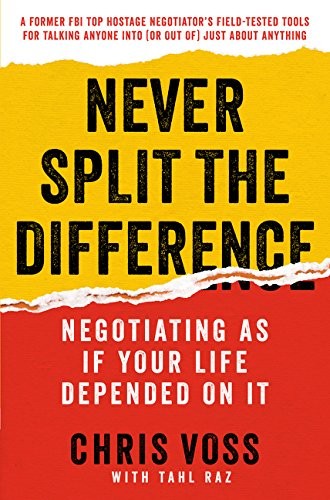
  • Chris Voss & Tahl Raz (2016) Never Split the Difference: Negotiating As If Your Life Depended On It HarperBusiness
  • Matthew D. Lieberman et al. (2007) Putting Feelings Into Words: Affect Labeling Disrupts Amygdala Activity in Response to Affective Stimuli Psychological Science, 18(5), 421-428, DOI: 10.1111/j.1467-9280.2007.01916.x

Quick exercise

Test yourself before answering

Answer in your head, then reveal the solution. Memory is built through active recall.

1 Quels signaux doivent vous alerter ?
  • Heavy flattery
  • Appeals to guilt or fear
  • Creating a moral debt
2 Quelles parades appliquer ?
  • Separate the emotion from the substance
  • Defer your answer
  • Come back to facts and figures

Frequently asked questions

The questions we get most

What is the "The Emotional Labeling Technique" technique?

Labelling consists in naming out loud the emotion you perceive in your counterpart: “it sounds like this deadline is worrying you”, “it seems that you don't feel respected”. By verbalising the emotion, you defuse it and demonstrate a deep understanding, without ever conceding the substance of the matter.

Is the "The Emotional Labeling Technique" technique ethical?

It sits on the line: effective, but it can tip into manipulation if it exploits an information asymmetry. Use it with measure and without deliberate deceit.

How do you defend against "The Emotional Labeling Technique"?

Mistaking an emotional bond for an objective argument. The right reflex: separate the emotion from the substance.

What is the "The Emotional Labeling Technique" technique based on?

NEGOCOACH does not assess the experimental validation of this technique in isolation. What we document is the grounding of its source school (FBI · Chris Voss): school grounded in research and field practice. Full detail is in the "At a glance" section of this page.

Practise with AI

Three ready-to-use prompts

Copy, paste into your assistant, replace the [brackets]. Works with ChatGPT, Claude, Gemini, Mistral, Perplexity.

Prepare

Build your plan before the meeting

You are an expert negotiation coach. Help me prepare to use the "The Emotional Labeling Technique" technique in the following situation: [describe your situation]. Give me: the conditions for success, a 3-step script, my counterpart's likely objections and how to answer them.

Simulate

Rehearse against an AI counterpart

Play the role of my counterpart in a negotiation. I am going to test the "The Emotional Labeling Technique" technique. React realistically and with resistance, do not give in too quickly, then at the end analyse my performance and suggest 3 concrete improvements.

Debrief

Analyse a past negotiation

Here is how my negotiation went: [paste the exchanges]. Analyse whether the "The Emotional Labeling Technique" technique was used well, what worked, the mistakes made, and spell out precisely what I could have done better.

References

Bibliography & credible sources

Founding works of the 🕵️ FBI · Chris Voss school this technique belongs to.

  • Cover: Never Split the Difference

    Never Split the Difference

    Book

    C. Voss & T. Raz · 2016

    The FBI's hostage-negotiation methods transposed to business and everyday life: tactical empathy, mirroring, labeling, calibrated questions. An emotional, counter-intuitive approach to persuasion.

  • Cover: Stalling for Time, My Life as an FBI Hostage Negotiator

    Stalling for Time, My Life as an FBI Hostage Negotiator

    Book

    G. Noesner · 2010

    The account of twenty-three years of crisis negotiation at the FBI by the head of its unit. A demonstration of the power of listening, patience and de-escalation in the most tense situations.

Chris Voss, "Never Split the Difference", 2016, FBI crisis negotiation.

On video

See the technique in action

Videos to picture The Emotional Labeling Technique and anchor it through examples.

A verified video selection is being enriched; the search above already surfaces the best videos on the topic.

Technique map

Where this technique sits

Every technique sits within a network: what it draws on, what it combines with, where it applies, and how to defend against it.

Levers engaged

biases & emotions

Countered by

Spot its signals, neutralise it and turn it around with the defensive playbook on this page.

See the counter-techniques

Key takeaways

  • En une phrase

    Labelling consists in naming out loud the emotion you perceive in your counterpart: “it sounds like this deadline is worrying you”, “it seems that you don't feel respected”. By verbalising the emotion, you defuse it and demonstrate a deep understanding, without ever conceding the substance of the matter.

  • The right reflex

    Verbalise the lever: "I feel you're playing on guilt", and naming it defuses it.

  • Never do this

    Mistaking an emotional bond for an objective argument.

8.3/10 tactical potential High vigilance School grounded in research and field practice

Master this technique in real situations?

Our programmes turn theory into a concrete advantage.

Explore our programmes
Call Book a call