Context 1 / 6
Sales negotiation
For a contract valued at £100,000, the buyer anchors at £65,000, then proposes £85,000, £95,000 and ends at £97,850. The final tiny increase and the precise figure convince the seller to accept.

🕵️ FBI · Chris Voss
Tactical empathy
Chris Voss, "Never Split the Difference", 2016, FBI crisis negotiation.
Full detail in the “Origin & history” section below.

Author of the library
Negotiation lecturer at KEDGE Business School
A rare threefold background serving negotiation: teaching, commercial justice and audit, backed by experience as a company director in Bordeaux.
The Ackerman model is a four-tier offer method: aim for 65% of your target, then move up to 85%, 95% and finally 100%, using precise, non-round figures (for example £37,450 rather than £37,000). The diminishing concessions give the other side the feeling of having wrung out the maximum.
At a glance
Vigilance: low (3.5/10) · Preparation required: 6/10
Indicative profile: it situates the “Managing concessions” family as the FBI · Chris Voss school practises it, not this technique taken in isolation. Techniques from the same family and school therefore share the same profile. NEGOCOACH editorial rating out of 10, non-experimental · the higher the “relational risk” value, the more costly the technique is to the relationship.
NEGOCOACH assessment
Tactical potential 6.3/10 (effectiveness, impact, discretion) and vigilance low (relational and ethical risk): two distinct readings, deliberately never merged into a single score that would reward risk. NEGOCOACH editorial rating calibrated from the “Managing concessions” family and the “FBI · Chris Voss” school. Each criterion is rated out of 10; click to understand what it measures.
How far the technique can carry the negotiation in the intended direction when it is well executed.
Strength of the effect produced on the counterpart's perceptions, emotions and decisions.
How hard it is for the other party to notice the technique is being used. A high value = very discreet.
The information, analysis and rehearsal required upfront to use it effectively.
Potential cost to the relationship and to trust if the technique is spotted, refused or fails. A high value = riskier.
Moral acceptability: fairness, transparency and respect for the counterpart's autonomy. A high value = more defensible.
School grounded in research and field practice
The school this technique stems from combines academic work with long field practice. This indicator qualifies the school, not this technique taken in isolation.
Indicative NEGOCOACH editorial rating, for teaching purposes. For “Relational risk”, a high value signals a cost to the relationship, not a quality.
The method is named after Mike Ackerman, a former CIA agent who became a hostage-release consultant and founder of the Ackerman Group in Miami. Faced with kidnappers demanding colossal ransoms, he devised a system of calibrated offers, 65, 85, 95 then 100% of the real budget, to convince the other camp that he had reached the absolute limit. The FBI adopted the method, and Chris Voss popularised it with the general public. Born in the extreme world of kidnapping, it proved formidably effective in any numbers-based negotiation, from buying a car to a corporate merger.
Systematised by the FBI school of negotiation, this technique combines anchoring, calibrated concessions and the effect of precise figures (perceived as considered and non-negotiable). Each tier smaller than the last signals that you are approaching your real limit, which pushes the other party to close.
Application by context
For a contract valued at £100,000, the buyer anchors at £65,000, then proposes £85,000, £95,000 and ends at £97,850. The final tiny increase and the precise figure convince the seller to accept.
In a collective pay negotiation, the unions first ask for a 6% rise, then successively accept 4%, 2.5% and 2.1%, the last minuscule step signalling that they have reached their floor.
A negotiator secures the release of hostages in diminishing batches (ten, then four, then two, then one), each smaller concession lending credibility to the idea that he has nothing left to give.
On a budget, one party proposes a 65% cut, then 85, 95 and 98%, the tightening tiers giving the opponent the feeling of having obtained everything.
Faced with a property at £300,000, the buyer offers £250,000, then £275,000, £290,000 and £293,500. The precise figures and the narrow final step carry the seller's decision.
In a division of assets, one party offers to take on 65% of the costs, then 85, 95 and 97%, the diminishing progression making the agreement acceptable to all.
Counter-techniques
Negotiation is also played on defence. Here is how to recognise this technique when it is used against you, and turn it around.
The signals that give it away
The counters that defuse it
Turn it into an advantage
Answer any request with a symmetrical one: "If I do that, what do you do?"
Giving for free to "make a gesture".
The model disciplines the escalation of concessions and exploits two powerful levers: the shrinking of the steps and the precise figures. Its limitation: it assumes you know your real target and your margin; against a seasoned negotiator who recognises the pattern, the effect wears off.
Perfect for numbers-based negotiations (price, salary, budget) where you have margin and time. To be avoided when only a single exchange is possible or when the relationship demands transparency rather than haggling.
Diplomatic · Hostage ransoms at the FBI: Chris Voss, former lead negotiator for international hostage-taking at the FBI, recounts in “Never Split the Difference” that for years he applied the formula inherited from agent Mike Ackerman when facing kidnappers. Rather than splitting the difference, he started from a deliberately low offer (around 65% of the sum sought), then moved up in ever smaller tiers, each time getting the kidnappers to formulate a counter-demand. The diminishing concessions signalled that he was scraping the last available margin, and the final amount, precise and non-rounded, made credible the idea that there was nothing left to obtain.
Everyday life · Buying a used car: A buyer is after a car listed at £10,000, with a personal target price of £8,000. He opens at £5,200 (65% of his target), justifying it calmly on the basis of condition and market, and invites the seller to react. After exchanges, he moves up to £6,800 (85%), then £7,600 (95%), and finally £7,987 (100%, a precise amount), adding that he will take the vehicle as it stands without asking for a service. The ever-shorter tiers and the non-round figure signal that he is genuinely at the end of his budget.
The model adds no value to the offer: it stages the manner in which you give ground. That is where the ethical question lies, and it is subtler than it appears, because the method has a perfectly healthy side: imposing on yourself a calculated trajectory of concessions before the session protects you from yourself, from the need to please and from concessions given away in the emotion of the moment. Used this way, it is personal discipline. The questionable side lies in the signals it manufactures. The precise figure (£37,450 rather than £37,000) is effective because it suggests a calculation that, most often, does not exist. The diminishing concessions are effective because they signal a limit you are approaching, whereas the final tier was decided in advance. The technique does not lie about the price, it lies about its own effort, and the other side pays a premium of satisfaction for a victory that was conceded to it. Structuring your concessions so as not to give ground at random is discipline; manufacturing the signs of a limit you have not reached is a charade.
Quick exercise
Answer in your head, then reveal the solution. Memory is built through active recall.
Frequently asked questions
The Ackerman model is a four-tier offer method: aim for 65% of your target, then move up to 85%, 95% and finally 100%, using precise, non-round figures (for example £37,450 rather than £37,000). The diminishing concessions give the other side the feeling of having wrung out the maximum.
Yes. Used in good faith it stays within a fair negotiation: it structures the exchange without deceiving the other party. Being transparent about your intentions strengthens the long-term relationship.
Giving for free to "make a gesture". The right reflex: quantify the real value of each point.
NEGOCOACH does not assess the experimental validation of this technique in isolation. What we document is the grounding of its source school (FBI · Chris Voss): school grounded in research and field practice. Full detail is in the "At a glance" section of this page.
Practise with AI
Copy, paste into your assistant, replace the [brackets]. Works with ChatGPT, Claude, Gemini, Mistral, Perplexity.
Build your plan before the meeting
You are an expert negotiation coach. Help me prepare to use the "The Ackerman Model Technique" technique in the following situation: [describe your situation]. Give me: the conditions for success, a 3-step script, my counterpart's likely objections and how to answer them.
Rehearse against an AI counterpart
Play the role of my counterpart in a negotiation. I am going to test the "The Ackerman Model Technique" technique. React realistically and with resistance, do not give in too quickly, then at the end analyse my performance and suggest 3 concrete improvements.
Analyse a past negotiation
Here is how my negotiation went: [paste the exchanges]. Analyse whether the "The Ackerman Model Technique" technique was used well, what worked, the mistakes made, and spell out precisely what I could have done better.
References
Founding works of the 🕵️ FBI · Chris Voss school this technique belongs to.
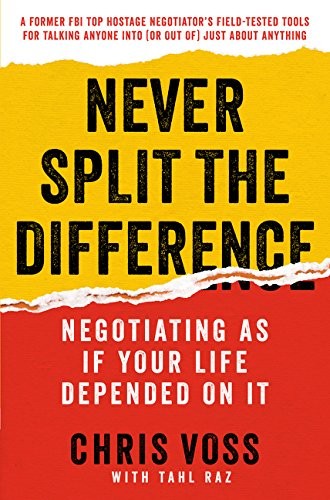
Never Split the Difference
BookC. Voss & T. Raz · 2016
The FBI's hostage-negotiation methods transposed to business and everyday life: tactical empathy, mirroring, labeling, calibrated questions. An emotional, counter-intuitive approach to persuasion.

Stalling for Time, My Life as an FBI Hostage Negotiator
BookG. Noesner · 2010
The account of twenty-three years of crisis negotiation at the FBI by the head of its unit. A demonstration of the power of listening, patience and de-escalation in the most tense situations.
Chris Voss, "Never Split the Difference", 2016, FBI crisis negotiation.
On video
Videos to picture The Ackerman Model Technique and anchor it through examples.
A verified video selection is being enriched; the search above already surfaces the best videos on the topic.
Technique map
Every technique sits within a network: what it draws on, what it combines with, where it applies, and how to defend against it.
Spot its signals, neutralise it and turn it around with the defensive playbook on this page.
See the counter-techniquesThe Ackerman model is a four-tier offer method: aim for 65% of your target, then move up to 85%, 95% and finally 100%, using precise, non-round figures (for example £37,450 rather than £37,000). The diminishing concessions give the other side the feeling of having wrung out the maximum.
Answer any request with a symmetrical one: "If I do that, what do you do?"
Giving for free to "make a gesture".
Our programmes turn theory into a concrete advantage.