
NEGOCOACH
258
Origin : FBI · Chris Voss

🕵️ FBI · Chris Voss

Tactical empathy

Chris Voss, "Never Split the Difference", 2016, FBI crisis negotiation.

Full detail in the “Origin & history” section below.

258

Labeling

Emotional intelligence Technique 258 / 360
Alexandre Baumberger

Author of the library

Alexandre Baumberger

Negotiation lecturer at KEDGE Business School

A rare threefold background serving negotiation: teaching, commercial justice and audit, backed by experience as a company director in Bordeaux.

  • Teaching, KEDGE Business School Negotiation lecturer since 2014 (12 years).
  • Commercial justice, Commercial Court Judge from 2018 to 2026: litigation, then insolvency proceedings.
  • Audit & advisory, over 20 years Tax, employment and financial audit in major firms, for large groups.
In brief

Labelling (emotional labelling) consists in explicitly naming the emotion perceived in the other party through an observational formula ("It sounds like…", "It seems that…"). A central tool of Chris Voss's tactical empathyi, it defuses negative emotions and reinforces positive ones, without ever appropriating the other party's feelings.

Reading level

At a glance

Its family profile at a glance

Effectiveness Psychologicalimpact Discretion Preparation Relationalrisk Ethics
8.0 / 10 Tactical potential

Vigilance: moderate (4.0/10) · Preparation required: 6/10

Grounding in the source school School grounded in research and field practice

Indicative profile: it situates the “Emotional intelligence” family as the FBI · Chris Voss school practises it, not this technique taken in isolation. Techniques from the same family and school therefore share the same profile. NEGOCOACH editorial rating out of 10, non-experimental · the higher the “relational risk” value, the more costly the technique is to the relationship.

NEGOCOACH assessment

How to read this rating

Tactical potential 8.0/10 (effectiveness, impact, discretion) and vigilance moderate (relational and ethical risk): two distinct readings, deliberately never merged into a single score that would reward risk. NEGOCOACH editorial rating calibrated from the “Emotional intelligence” family and the “FBI · Chris Voss” school. Each criterion is rated out of 10; click to understand what it measures.

  • Effectiveness 8/10 · Very high

    How far the technique can carry the negotiation in the intended direction when it is well executed.

  • Psychological impact 10/10 · Very high

    Strength of the effect produced on the counterpart's perceptions, emotions and decisions.

  • Discretion 6/10 · High

    How hard it is for the other party to notice the technique is being used. A high value = very discreet.

  • Preparation 6/10 · High

    The information, analysis and rehearsal required upfront to use it effectively.

  • Relational risk 3/10 · Low

    Potential cost to the relationship and to trust if the technique is spotted, refused or fails. A high value = riskier.

  • Ethics 6/10 · High

    Moral acceptability: fairness, transparency and respect for the counterpart's autonomy. A high value = more defensible.

Level of evidence

School grounded in research and field practice

The school this technique stems from combines academic work with long field practice. This indicator qualifies the school, not this technique taken in isolation.

Indicative NEGOCOACH editorial rating, for teaching purposes. For “Relational risk”, a high value signals a cost to the relationship, not a quality.

Labelling in Brief


Origin & History

The term originates in affective neuroscience research: affect labelling refers to putting an emotion into words. Chris Voss turns it into a negotiation tool in Never Split the Difference (2016), drawing on the work of Matthew Liebermani, who showed that verbalising an emotion diminishes amygdala activity.


Definition and Principle

A label is an observation, not a question: you state what the other party appears to be feeling and then fall silent to let them confirm or correct it. Its strength lies in the implied third-person phrasing ("it seems that…") rather than the "I" ("I think that you…"), which assigns responsibility and puts people on the defensive. Well framed, it opens up dialogue; poorly framed, it comes across as presumptuous.


Concrete Examples of Application

Application by context

The same technique, across every negotiation settings

Context 1 / 8

Sales negotiation

A prospect hesitates without saying why. The salesperson offers a label: "It sounds like something in this offer is still holding you back." The prospect confirms and spells out a concern about after-sales service, which the salesperson can then address directly.

How to apply it

Phrase the perceived doubt as a neutral observation, without "I", then leave a three-second silence for the prospect to fill in.

Strengths

Draws out the real objection without an interrogation; the other party feels they are leading.

Weaknesses

A mistaken label ("you seem worried about the price" when that isn't it) can lead the exchange astray.
Context 2 / 8

Procurement negotiation

Faced with a supplier who locks down their terms, the buyer labels the stance: "It seems that you have little latitude on these clauses." To defend themselves, the supplier explains where their real room for negotiation actually lies.

How to apply it

Label the displayed rigidity rather than challenging it head-on; the other party's defence reveals their true flexibilities.

Strengths

Obtains a map of the negotiable points without having asked a single confrontational question.

Weaknesses

If the label is too flattering or too accusatory, the supplier digs in instead of explaining.

Context 3 / 8

Labour negotiation

In a tense team meeting, a manager labels the mood: "I get the impression there's some weariness about these repeated changes." Naming the collective unspoken feeling brings the tension down and releases speech that had until then been held back.

How to apply it

Name the group's emotion before the agenda; the labelling acts as a release valve that makes what follows productive.

Strengths

Turns a diffuse unease into a discussable topic; strengthens the manager's legitimacy as a listener.

Weaknesses

Without concrete follow-through, repeated labelling becomes an empty formula that irritates.

Context 4 / 8

Crisis management

Faced with a person in distress, the responder strings together labels ("It sounds like you feel trapped, like you feel there's no way out") to bring the emotional intensity down before any attempt at resolution.

How to apply it

Label the negative emotions one after another until the other party assents; that is the signal the amygdala is calming down.

Strengths

Fast and reliable de-escalation, even when no rational argument gets through.

Weaknesses

A mechanical or rehearsed tone, noticeable in extreme situations, ruins the effect and can reignite aggression.

Context 5 / 8

Political negotiation

In a deadlocked multi-party negotiation, a mediator labels the shared frustration: "It seems that everyone feels they have already conceded a great deal." Acknowledging this shared feeling recreates common ground from which to move forward.

How to apply it

Label the emotion common to all parties rather than that of one camp, so as not to appear biased.

Strengths

Restores a cooperative climate without conceding the substance to anyone.

Weaknesses

A label perceived as favouring one party compromises the mediator's neutrality.

Context 6 / 8

Real-estate negotiation

A buyer piles on criticisms of the property. The agent labels: "It sounds like you're mainly looking to reassure yourself that this is the right choice." Feeling acknowledged in their hesitation, the buyer finally voices their real fear: the financing.

How to apply it

Behind the nitpicking criticisms, label the decision anxiety; it is often that, not the property, which is the sticking point.

Strengths

Refocuses the exchange on the real obstacle and avoids getting lost defending every flaw pointed out.

Weaknesses

It can feel like an intrusive psychologising if the relationship is not yet established.

Context 7 / 8

Cross-cultural negotiation

With a counterpart from a culture where the direct expression of emotions is frowned upon, a negotiator replaces "you seem disappointed" with a labelling of the situation: "It seems that this timeline is hard to meet on your side." They name the fact, not the private feeling.

How to apply it

Shift the label from the emotion to the situation in reserved cultures; the soothing effect remains without the risk of awkwardness.

Strengths

Preserves face and respects local codes, a precondition for trust internationally.

Weaknesses

A direct emotional label, imported as is, can shock and block the exchange.

Context 8 / 8

Family negotiation

A parent in conflict with their teenager labels the feeling: "I get the impression you feel we decide everything for you." Naming the need for autonomy soothes, where arguing would only have intensified the opposition.

How to apply it

Label the need beneath the behaviour (autonomy, recognition) rather than punishing the behaviour itself.

Strengths

Opens dialogue and avoids escalation; the other party feels understood before being contradicted.

Weaknesses

A label used as a preamble to a reproach is quickly perceived as manipulative.


Counter-techniques

Spot and neutralise this technique

Negotiation is also played on defence. Here is how to recognise this technique when it is used against you, and turn it around.

Detect

The signals that give it away

  • Displayed empathy that lowers your guard
  • Mirroring of your gestures and words
  • A systematic "I understand you"

Neutralise

The counters that defuse it

  • Appreciate the warmth without relaxing
  • Keep your objectives in mind
  • Distinguish being heard from being satisfied

Turn around

Turn it into an advantage

Use active listening in turn to gather information.

The trap to avoid

Mistaking being understood for having won your case.

In Short

  • Difficulty: Accessible
  • Estimated effectiveness: High
  • Time to implement: Immediate
  • Fields of application: Sales, Crisis negotiation, Management, Mediation, Customer relations
  • Synonyms: Emotional labelling, Affect labelling, Naming the emotion
  • Tags: labelling, tactical empathy, Chris Voss, affect labelling, de-escalation

Strengths and Weaknesses

Labelling is one of the fastest and most reliable emotional tools: a single well-phrased sentence lowers tension and releases information. It concedes nothing and is quick to master. Its weakness: it rests entirely on the accuracy of the emotional reading; a false or mechanical label immediately backfires on its author.


When to Use This Technique

Use it as soon as an emotion is interfering with the exchange or an unspoken matter is causing a blockage, and at the opening to establish rapport. Avoid it in rapid succession (the effect wears off) and in purely transactional exchanges. It is to be banned as a mechanical preamble to a reproach, where it becomes counterproductive.


How to Recognise and Counter This Technique

Recognise it: the other party strings together "it sounds like…", "it seems that you…" followed by emphatic silences. Neutralise it: briefly acknowledge receipt ("Yes, that's roughly it") without elaborating, then take back control of the substance. Turn it around: place a label of your own on their state ("It sounds like this matter means a great deal to you") to reverse the dynamic.


Limits and Ethics

Labelling touches on the intimate: poorly calibrated, it becomes an intrusive psychologising or a tool of manipulation when it sets up a forced concession. In a context of vulnerability, naming an emotion in order to exploit it is ethically indefensible. The rule: label to understand and soothe, never to entrap.


Variants and Related Techniques

A constituent element of Tactical empathy; it combines with verbal mirroring and silence. Close to the reflection of feeling in Rogerian listening and to empathetic reformulation. The "anticipated accusation" label (accusation audit) is a defensive variant of it: naming the expected reproaches yourself in order to defuse them.


Going Further

  • Chris Voss & Tahl Raz, Never Split the Difference, chapter on labelling and the accusation audit, 2016.
  • Matthew Lieberman et al., "Putting Feelings Into Words: Affect Labeling Disrupts Amygdala Activity", Psychological Science, 2007.
  • Marshall Rosenberg, Nonviolent Communication: A Language of Life, 1999.

Objectives of the Technique

  • Defuse a negative emotion (anger, fear, distrust) by naming it aloud, which reduces its intensity in the other party
  • Create a feeling of being understood (tactical empathy) that builds trust without conceding anything on the substance
  • Bring hidden information to the surface: a label, even an imperfect one, prompts the other party to correct, clarify and thus reveal their real position
  • Amplify positive emotions (pride, relief, the desire to reach agreement) in order to anchor cooperation
  • Slow down the exchange and regain control of the emotional climate of the negotiation without direct confrontation

Famous Cases

Law enforcement · The Harlem siege: three fugitives come out without a shot fired: A real case documented by Chris Voss in "Never Split the Difference" (2016). Three armed fugitives, suspected of a shooting, are holed up in a Harlem apartment. No telephone contact is possible. Voss, then an FBI crisis negotiator in New York, speaks through the door for around six hours, in his calm "late-night DJ" voice, stringing together labels: "It sounds like you don't want to come out. It sounds like you're afraid that if you open the door, we'll come in shooting. It sounds like you don't want to go back to prison." No reply for hours, then the three men surrender without violence. They later explained that this voice, which named their fears exactly, had calmed them and convinced them the negotiators would not leave.

Commercial · The customer furious over a late delivery (representative scenario): A representative scenario, not attributed to real people. A procurement director summons their supplier after a third late delivery and threatens to terminate the contract. Rather than justifying herself (schedule, subcontractor, weather), the salesperson opens with a label: "It sounds like these delays are putting you in a difficult position with your own management, and like you feel you can no longer rely on us." The director exhales, confirms, and details his real problem: a commitment made before his committee. The discussion then shifts from sanction to a joint plan (buffer stock, capped penalties, a weekly check-in). The label conceded nothing, but it turned a prosecution into problem-solving.


Common Mistakes

  • Starting the label with "I" ("I understand that you are angry"): this recentres the exchange on yourself and triggers defensiveness; prefer the neutral turns "It sounds like…", "It seems that…", "I get the impression that…"
  • Speaking straight after the label: following up with an argument or a justification cancels the effect; you must stay silent and let the silence do its work
  • Asserting the emotion as a fact ("You are furious") instead of a gentle hypothesis: an overly assertive label puts people on the defensive, whereas a cautious label, even a wrong one, simply invites the other party to correct it
  • Confusing labelling with agreement: naming the other party's emotion or position does not mean agreeing with them or conceding on the substance
  • Labelling in rapid succession, mechanically: the device becomes visible and is perceived as manipulative; the label must remain occasional, sincere and grounded in a genuine observation

Scientific Foundations

  • Chris Voss and Tahl Raz (2016) Never Split the Difference: Negotiating As If Your Life Depended On It HarperBusiness
  • Matthew D. Lieberman, Naomi I. Eisenberger, Molly J. Crockett, Sabrina M. Tom, Jennifer H. Pfeifer and Baldwin M. Way (2007) Putting Feelings Into Words: Affect Labeling Disrupts Amygdala Activity in Response to Affective Stimuli Psychological Science, 18(5), 421-428, DOI: 10.1111/j.1467-9280.2007.01916.x

Quick exercise

Test yourself before answering

Answer in your head, then reveal the solution. Memory is built through active recall.

1 Quels signaux doivent vous alerter ?
  • Displayed empathy that lowers your guard
  • Mirroring of your gestures and words
  • A systematic "I understand you"
2 Quelles parades appliquer ?
  • Appreciate the warmth without relaxing
  • Keep your objectives in mind
  • Distinguish being heard from being satisfied

Frequently asked questions

The questions we get most

What is the "Labeling" technique?

Labelling (emotional labelling) consists in explicitly naming the emotion perceived in the other party through an observational formula ("It sounds like…", "It seems that…"). A central tool of Chris Voss's tactical empathyi, it defuses negative emotions and reinforces positive ones, without ever appropriating the other party's feelings.

Is the "Labeling" technique ethical?

It sits on the line: effective, but it can tip into manipulation if it exploits an information asymmetry. Use it with measure and without deliberate deceit.

How do you defend against "Labeling"?

Mistaking being understood for having won your case. The right reflex: appreciate the warmth without relaxing.

What is the "Labeling" technique based on?

NEGOCOACH does not assess the experimental validation of this technique in isolation. What we document is the grounding of its source school (FBI · Chris Voss): school grounded in research and field practice. Full detail is in the "At a glance" section of this page.

Practise with AI

Three ready-to-use prompts

Copy, paste into your assistant, replace the [brackets]. Works with ChatGPT, Claude, Gemini, Mistral, Perplexity.

Prepare

Build your plan before the meeting

You are an expert negotiation coach. Help me prepare to use the "Labeling" technique in the following situation: [describe your situation]. Give me: the conditions for success, a 3-step script, my counterpart's likely objections and how to answer them.

Simulate

Rehearse against an AI counterpart

Play the role of my counterpart in a negotiation. I am going to test the "Labeling" technique. React realistically and with resistance, do not give in too quickly, then at the end analyse my performance and suggest 3 concrete improvements.

Debrief

Analyse a past negotiation

Here is how my negotiation went: [paste the exchanges]. Analyse whether the "Labeling" technique was used well, what worked, the mistakes made, and spell out precisely what I could have done better.

References

Bibliography & credible sources

Founding works of the 🕵️ FBI · Chris Voss school this technique belongs to.

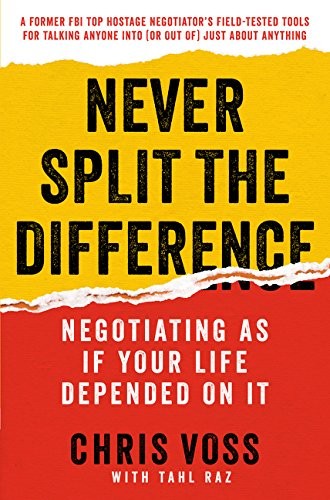
  • Cover: Never Split the Difference

    Never Split the Difference

    Book

    C. Voss & T. Raz · 2016

    The FBI's hostage-negotiation methods transposed to business and everyday life: tactical empathy, mirroring, labeling, calibrated questions. An emotional, counter-intuitive approach to persuasion.

  • Cover: Stalling for Time, My Life as an FBI Hostage Negotiator

    Stalling for Time, My Life as an FBI Hostage Negotiator

    Book

    G. Noesner · 2010

    The account of twenty-three years of crisis negotiation at the FBI by the head of its unit. A demonstration of the power of listening, patience and de-escalation in the most tense situations.

Chris Voss, "Never Split the Difference", 2016, FBI crisis negotiation.

On video

See the technique in action

Videos to picture Labeling and anchor it through examples.

Technique map

Where this technique sits

Every technique sits within a network: what it draws on, what it combines with, where it applies, and how to defend against it.

Levers engaged

biases & emotions

Countered by

Spot its signals, neutralise it and turn it around with the defensive playbook on this page.

See the counter-techniques

Key takeaways

  • En une phrase

    Labelling (emotional labelling) consists in explicitly naming the emotion perceived in the other party through an observational formula ("It sounds like…", "It seems that…"). A central tool of Chris Voss's tactical empathyi, it defuses negative emotions and reinforces positive ones, without ever appropriating the other party's feelings.

  • The right reflex

    Use active listening in turn to gather information.

  • Never do this

    Mistaking being understood for having won your case.

8.0/10 tactical potential Moderate vigilance School grounded in research and field practice

Master this technique in real situations?

Our programmes turn theory into a concrete advantage.

Explore our programmes
Call Book a call