NEGOCOACH
142
Origin : Methods & tactics

🛠️ Methods & tactics

Anglo-Saxon schools of negotiation

C. Karrass, R. Dawson, H. Cohen, N. Rackham (SPIN), T. Gordon (DESC / active listening).

Full detail in the “Origin & history” section below.

142

The SPIN Method Technique

Communication tactics Technique 142 / 360
Alexandre Baumberger

Author of the library

Alexandre Baumberger

Negotiation lecturer at KEDGE Business School

A rare threefold background serving negotiation: teaching, commercial justice and audit, backed by experience as a company director in Bordeaux.

  • Teaching, KEDGE Business School Negotiation lecturer since 2014 (12 years).
  • Commercial justice, Commercial Court Judge from 2018 to 2026: litigation, then insolvency proceedings.
  • Audit & advisory, over 20 years Tax, employment and financial audit in major firms, for large groups.
In brief

The SPIN method structures the discovery phase through four types of question, in order: Situation (the facts), Problem (the difficulties), Implication (the consequences of the problem) and Need-payoff (the value of the solution). By getting the other party to articulate for themselves the scale of their problem and the interest in remedying it, you sell without having to argue.

Reading level

At a glance

Its family profile at a glance

Effectiveness Psychologicalimpact Discretion Preparation Relationalrisk Ethics
6.7 / 10 Tactical potential

Vigilance: low (3.5/10) · Preparation required: 4/10

Grounding in the source school School grounded in research and field practice

Indicative profile: it situates the “Communication tactics” family as the Methods & tactics school practises it, not this technique taken in isolation. Techniques from the same family and school therefore share the same profile. NEGOCOACH editorial rating out of 10, non-experimental · the higher the “relational risk” value, the more costly the technique is to the relationship.

NEGOCOACH assessment

How to read this rating

Tactical potential 6.7/10 (effectiveness, impact, discretion) and vigilance low (relational and ethical risk): two distinct readings, deliberately never merged into a single score that would reward risk. NEGOCOACH editorial rating calibrated from the “Communication tactics” family and the “Methods & tactics” school. Each criterion is rated out of 10; click to understand what it measures.

  • Effectiveness 7/10 · High

    How far the technique can carry the negotiation in the intended direction when it is well executed.

  • Psychological impact 6/10 · High

    Strength of the effect produced on the counterpart's perceptions, emotions and decisions.

  • Discretion 7/10 · High

    How hard it is for the other party to notice the technique is being used. A high value = very discreet.

  • Preparation 4/10 · Moderate

    The information, analysis and rehearsal required upfront to use it effectively.

  • Relational risk 3/10 · Low

    Potential cost to the relationship and to trust if the technique is spotted, refused or fails. A high value = riskier.

  • Ethics 7/10 · High

    Moral acceptability: fairness, transparency and respect for the counterpart's autonomy. A high value = more defensible.

Level of evidence

School grounded in research and field practice

The school this technique stems from combines academic work with long field practice. This indicator qualifies the school, not this technique taken in isolation.

Indicative NEGOCOACH editorial rating, for teaching purposes. For “Relational risk”, a high value signals a cost to the relationship, not a quality.

Summary of the SPIN METHOD


Origin & history

The method was developed by Neil Rackham on the basis of a massive empirical study: the analysis of more than 35,000 real sales interviews, published in SPIN Selling (1988). Rackham found that aggressive techniques work for small sales but fail for complex sales, where it is the quality of the questioning that makes the difference. The best salespeople do not present their product: they ask questions that lead the customer to verbalise their own need. SPIN remains one of the most widely taught sales methods in the world.


Definition and principle

The technique consists in stringing together Situation questions, then Problem questions, then Implication questions (to amplify awareness of the problem), and finally Need-payoff questions (to get the other party to state the benefits of the solution). The other party convinces themselves.


Concrete examples of application

Application by context

The same technique, across several negotiation settings

Context 1 / 6

Sales negotiation

A salesperson gets the customer to describe their situation, their difficulties, the quantified consequences of those difficulties, and then the value of a solution; the customer concludes on their own that they should buy.
Context 2 / 6

Labour negotiation

In negotiation, you question management about the consequences of an unresolved labour problem, getting them to gauge the value of an agreement.

Context 3 / 6

Crisis management

The negotiator gets the party to articulate for themselves the consequences of the deadlock and the benefits of a way out.

Context 4 / 6

Political negotiation

You get a partner to express the scale of a shared problem and the interest of a concerted response.

Context 5 / 6

Real-estate negotiation

An agent gets the seller to state the drawbacks of leaving the property unsold and the interest of adjusting the price.

Context 6 / 6

Family negotiation

In a conflict, you get each party to set out the consequences of the status quo and the benefits of an agreement.


Counter-techniques

Spot and neutralise this technique

Negotiation is also played on defence. Here is how to recognise this technique when it is used against you, and turn it around.

Detect

The signals that give it away

  • Long, heavy silences
  • Rapid-fire questions
  • Reformulations that distort what you said

Neutralise

The counters that defuse it

  • Tolerate silence without filling it
  • Take the lead with a question
  • Immediately correct abusive reformulations

Turn around

Turn it into an advantage

Use silence in turn: whoever speaks first often concedes.

The trap to avoid

Filling the void by giving up a concession.

Strengths and weaknesses

SPIN is rigorous, validated by research and formidable for complex negotiations: the other party persuades themselves. Its limits: it requires preparation and patience, and can seem mechanical if the questions sound like an interrogation instead of a genuine dialogue.


When to use this technique?

Ideal for complex, long-cycle sales and negotiations, where the need has to mature. Oversized for a simple, quick transaction.


Objectives of the technique

  • Get the customer to discover their own problems and needs through questioning rather than through argument, so that they convince themselves
  • Amplify the perceived value of a problem (via Implication questions) so that the cost of inaction appears greater than the price of the solution
  • Get the counterpart to articulate the expected benefits themselves (Need-payoff questions), which reduces their resistance and objections
  • Structure the discovery phase of a complex negotiation or sale into a logical progression: Situation → Problem → Implication → Solution
  • Adapt the depth of questioning to significant sales/stakes where the decision is considered and multi-criteria

Famous cases

Sales · Selling a software solution to an operations director: A management-software salesperson meets the operations director of an industrial SME. Rather than reeling off the features straight away, they open with Situation questions (how many orders do you process per day, with what current tools). They move on to Problem questions (are stock-outs frequent, does manual data entry generate errors). Then comes the decisive lever, the Implication questions: what does a stock-out cost in lost orders, how much time do your teams spend correcting entry errors, what effect on customer satisfaction. In answering, the director quantifies for themselves a shortfall they had never added up. Finally, the Need-payoff questions (if you could make your stock levels reliable in real time, what would your teams gain) lead the customer to state the value of the solution themselves. The product pitch comes only afterwards, in response to a need that is now explicit and owned by the buyer.

Corporate · Scoping meeting for an internal project: A digital-transformation lead wants to win over a department head who is reluctant to adopt a new tool. Instead of imposing the change, they apply the SPIN sequence in the meeting: Situation questions about the department's current organisation, Problem questions about the friction points felt by the team, Implication questions about the consequences of that friction (delays, overload, turnover), then Need-payoff questions about what a suitable tool would resolve. Having verbalised the problem and the benefit themselves, the department head becomes an advocate for the project instead of an opponent of it.


Common mistakes

  • Stringing together too many Situation questions (factual ones), which weary the counterpart and make them feel interrogated without adding value: Rackham shows that the best salespeople ask few of them
  • Presenting the solution too early, before having developed the Implication questions that create a sense of urgency: without perceived pain, the value seems expensive
  • Turning the questioning into a mechanical, scripted interrogation, instead of a dialogue that genuinely listens to the answers
  • Forgetting the Need-payoff questions and stating the benefits yourself: you lose the self-persuasion effect, since the customer must formulate the value themselves
  • Applying SPIN to small transactional sales where it is disproportionate: the method is designed for complex, long-cycle, high-stakes sales

Limits and ethics

SPIN grew out of a massive empirical study conducted by Neil Rackham, and its virtue is real: structuring discovery means listening before proposing, and the salesperson who questions serves their customer better than the one who recites. There is nothing to object to in the Situation and Problem stages, which merely establish facts. The whole question lies in the Implication stage, whose function is to amplify awareness of the problem before offering the solution. It is perfectly sound when the problem is real and underestimated: getting an executive to calculate what a breakdown they thought harmless costs them annually is informing them, and they will owe you that lucidity. It becomes a manufacturing of need as soon as the consequences are exaggerated, extrapolated or dramatised to make what you are selling necessary. One subtlety is worth knowing, for it is what makes the method so powerful: it is the other party who articulates the scale of the problem, so that they can no longer dispute it afterwards without contradicting themselves. Getting a real problem articulated is discovery; getting a pain you intend to sell amplified is a manufacturing of need.


Scientific foundations

  • Neil Rackham (1988) SPIN Selling McGraw-Hill, New York

Quick exercise

Test yourself before answering

Answer in your head, then reveal the solution. Memory is built through active recall.

1 Quels signaux doivent vous alerter ?
  • Long, heavy silences
  • Rapid-fire questions
  • Reformulations that distort what you said
2 Quelles parades appliquer ?
  • Tolerate silence without filling it
  • Take the lead with a question
  • Immediately correct abusive reformulations

Frequently asked questions

The questions we get most

What is the "The SPIN Method Technique" technique?

The SPIN method structures the discovery phase through four types of question, in order: Situation (the facts), Problem (the difficulties), Implication (the consequences of the problem) and Need-payoff (the value of the solution). By getting the other party to articulate for themselves the scale of their problem and the interest in remedying it, you sell without having to argue.

Is the "The SPIN Method Technique" technique ethical?

Yes. Used in good faith it stays within a fair negotiation: it structures the exchange without deceiving the other party. Being transparent about your intentions strengthens the long-term relationship.

How do you defend against "The SPIN Method Technique"?

Filling the void by giving up a concession. The right reflex: tolerate silence without filling it.

What is the "The SPIN Method Technique" technique based on?

NEGOCOACH does not assess the experimental validation of this technique in isolation. What we document is the grounding of its source school (Methods & tactics): school grounded in research and field practice. Full detail is in the "At a glance" section of this page.

Practise with AI

Three ready-to-use prompts

Copy, paste into your assistant, replace the [brackets]. Works with ChatGPT, Claude, Gemini, Mistral, Perplexity.

Prepare

Build your plan before the meeting

You are an expert negotiation coach. Help me prepare to use the "The SPIN Method Technique" technique in the following situation: [describe your situation]. Give me: the conditions for success, a 3-step script, my counterpart's likely objections and how to answer them.

Simulate

Rehearse against an AI counterpart

Play the role of my counterpart in a negotiation. I am going to test the "The SPIN Method Technique" technique. React realistically and with resistance, do not give in too quickly, then at the end analyse my performance and suggest 3 concrete improvements.

Debrief

Analyse a past negotiation

Here is how my negotiation went: [paste the exchanges]. Analyse whether the "The SPIN Method Technique" technique was used well, what worked, the mistakes made, and spell out precisely what I could have done better.

References

Bibliography & credible sources

Founding works of the 🛠️ Methods & tactics school this technique belongs to.

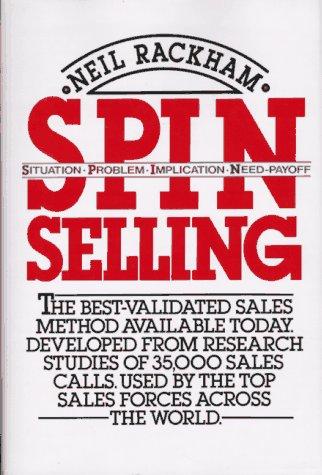
  • Cover: SPIN Selling

    SPIN Selling

    Book

    N. Rackham · 1988

    Grounded in the analysis of thousands of sales calls, the SPIN method structures customer discovery through four types of question (Situation, Problem, Implication, Need-payoff) for complex sales.

  • Cover: The Negotiating Game

    The Negotiating Game

    Book

    C. L. Karrass · 1970

    A pragmatic classic of business negotiation: tactics, power balance and preparation. Karrass sums up his motto, you get what you negotiate, not what you deserve.

  • Cover: Secrets of Power Negotiating

    Secrets of Power Negotiating

    Book

    R. Dawson · 1987

    An arsenal of opening, middle and closing "gambits" to gain the upper hand in commercial negotiation, explained step by step.

C. Karrass, R. Dawson, H. Cohen, N. Rackham (SPIN), T. Gordon (DESC / active listening).

On video

See the technique in action

Videos to picture The SPIN Method Technique and anchor it through examples.

A verified video selection is being enriched; the search above already surfaces the best videos on the topic.

Technique map

Where this technique sits

Every technique sits within a network: what it draws on, what it combines with, where it applies, and how to defend against it.

Key takeaways

  • En une phrase

    The SPIN method structures the discovery phase through four types of question, in order: Situation (the facts), Problem (the difficulties), Implication (the consequences of the problem) and Need-payoff (the value of the solution). By getting the other party to articulate for themselves the scale of their problem and the interest in remedying it, you sell without having to argue.

  • The right reflex

    Use silence in turn: whoever speaks first often concedes.

  • Never do this

    Filling the void by giving up a concession.

6.7/10 tactical potential Low vigilance School grounded in research and field practice

Master this technique in real situations?

Our programmes turn theory into a concrete advantage.

Explore our programmes
Call Book a call