Context 1 / 6
Sales negotiation
By digging deeper, a seller discovers that the buyer is under an unavoidable internal deadline: this hidden information becomes the real lever of the deal.

🕵️ FBI · Chris Voss
Tactical empathy
Chris Voss, "Never Split the Difference", 2016, FBI crisis negotiation.
Full detail in the “Origin & history” section below.

Author of the library
Negotiation lecturer at KEDGE Business School
A rare threefold background serving negotiation: teaching, commercial justice and audit, backed by experience as a company director in Bordeaux.
The black swan is the hidden piece of information that, once uncovered, changes everything: a constraint, a secret motivation, an unknown deadline. Assuming that there is always at least one black swan on the other side, and actively searching for it, transforms a negotiation.
At a glance
Vigilance: low (3.5/10) · Preparation required: 8/10
Indicative profile: it situates the “Structural negotiation” family as the FBI · Chris Voss school practises it, not this technique taken in isolation. Techniques from the same family and school therefore share the same profile. NEGOCOACH editorial rating out of 10, non-experimental · the higher the “relational risk” value, the more costly the technique is to the relationship.
NEGOCOACH assessment
Tactical potential 6.7/10 (effectiveness, impact, discretion) and vigilance low (relational and ethical risk): two distinct readings, deliberately never merged into a single score that would reward risk. NEGOCOACH editorial rating calibrated from the “Structural negotiation” family and the “FBI · Chris Voss” school. Each criterion is rated out of 10; click to understand what it measures.
How far the technique can carry the negotiation in the intended direction when it is well executed.
Strength of the effect produced on the counterpart's perceptions, emotions and decisions.
How hard it is for the other party to notice the technique is being used. A high value = very discreet.
The information, analysis and rehearsal required upfront to use it effectively.
Potential cost to the relationship and to trust if the technique is spotted, refused or fails. A high value = riskier.
Moral acceptability: fairness, transparency and respect for the counterpart's autonomy. A high value = more defensible.
School grounded in research and field practice
The school this technique stems from combines academic work with long field practice. This indicator qualifies the school, not this technique taken in isolation.
Indicative NEGOCOACH editorial rating, for teaching purposes. For “Relational risk”, a high value signals a cost to the relationship, not a quality.
Chris Voss borrowed the image from the statistician Nassim Nicholas Taleb (The Black Swan, 2007), who used it to describe rare, unforeseen, high-impact events. In Never Split the Difference (2016), Voss applies it to negotiation: he calls "Black Swans" the unknown pieces of information which, were they discovered, would overturn the deal. His conviction, forged on hostage cases where an overlooked detail changed everything, is that the best negotiator is not the one who speaks best, but the one who unearths what the other party does not say.
The technique consists in assuming that you are unaware of decisive elements and in conducting a genuine investigation (open questions, listening, observation, informal encounters) to bring them to the surface. A single black swan uncovered can reverse the balance of power.
Application by context
By digging deeper, a seller discovers that the buyer is under an unavoidable internal deadline: this hidden information becomes the real lever of the deal.
Management learns that an issue of recognition, not pay, is the representatives' true motivation, which reopens the negotiation.
The negotiator discovers the real fear driving the barricaded person, a decisive element that nothing had hinted at from the outset.
A delegation identifies a hidden domestic constraint on the other camp (pressure from its own base) that finally explains its positions.
The agent learns that the seller must close before a specific date for another purchase: this black swan changes the whole price negotiation.
In an inheritance, an unsuspected emotional attachment to an asset comes to light, explaining a deadlock that had until then been baffling.
Counter-techniques
Negotiation is also played on defence. Here is how to recognise this technique when it is used against you, and turn it around.
The signals that give it away
The counters that defuse it
Turn it into an advantage
Propose an alternative frame that favours you, rather than enduring theirs.
Accepting the other side's ground without ever discussing it.
Hunting for black swans turns information into power and avoids negotiating blind. Its limits: it demands time, curiosity and a genuine quality of listening; you do not always find a black swan, and an obsession with hidden information can lead you to neglect the deal within reach.
Invaluable in high-stakes negotiations where you suspect the other party has unspoken motivations or constraints. Less useful in a transparent transaction with no grey areas.
Sales · The price objection that concealed a deadline: A B2B supplier is stuck for weeks with a buyer who demands an "impossible" discount. Rather than continuing to defend his price, the seller adopts an investigative posture: open questions, listening for the unsaid, reformulations. He eventually uncovers a black swan: the buyer must close this contract before the accounting year-end, failing which he loses his budget. The real issue was not the price but the timeline. The seller then proposes a staggered payment and an immediate signature at full price: the deal is closed, each side getting what it needs. A representative scenario illustrating the mechanics of the technique.
Everyday life · The tenancy that was not about the rent: A prospective tenant, competing against other applications, stops raising the bid on the rent. In conversation, he learns that the landlord, who is elderly, above all dreads a poorly maintained home and frequent changes of tenant. This hidden information, that the real priority is stability and care rather than price, allows him to propose a long lease and to reassure the landlord about his reliability rather than matching a higher sum. He secures the property. A representative scenario.
Seeking the decisive information is the very heart of the craft: a negotiation conducted without understanding what really constrains the other party is played blind, and the black swan is often merely a name given to serious preparation. The difficulty lies in the nature of what you find. The black swan is almost always something the counterpart has reasons to keep quiet: a deadline that is strangling them, a personal difficulty, tight cash flow, an internal disagreement. To uncover it is to hold someone by their vulnerability, and two uses then open up, which have nothing in common. Using it to build an agreement that takes account of this constraint, often to the benefit of both, is what Voss teaches. Using it to press where it hurts is to turn a confidence into a means of pressure. The question of means matters just as much: what is asked and listened for is negotiation, what is gathered without the other party's knowledge belongs to a different discipline, and sometimes to an offence. Seeking the hidden information to build a solid agreement is preparation; seeking it to hold the other party by what they wanted to keep quiet is intelligence-gathering.
Quick exercise
Answer in your head, then reveal the solution. Memory is built through active recall.
Frequently asked questions
The black swan is the hidden piece of information that, once uncovered, changes everything: a constraint, a secret motivation, an unknown deadline. Assuming that there is always at least one black swan on the other side, and actively searching for it, transforms a negotiation.
Yes. Used in good faith it stays within a fair negotiation: it structures the exchange without deceiving the other party. Being transparent about your intentions strengthens the long-term relationship.
Accepting the other side's ground without ever discussing it. The right reflex: negotiate the frame before the substance.
NEGOCOACH does not assess the experimental validation of this technique in isolation. What we document is the grounding of its source school (FBI · Chris Voss): school grounded in research and field practice. Full detail is in the "At a glance" section of this page.
Practise with AI
Copy, paste into your assistant, replace the [brackets]. Works with ChatGPT, Claude, Gemini, Mistral, Perplexity.
Build your plan before the meeting
You are an expert negotiation coach. Help me prepare to use the "The Black Swan Technique" technique in the following situation: [describe your situation]. Give me: the conditions for success, a 3-step script, my counterpart's likely objections and how to answer them.
Rehearse against an AI counterpart
Play the role of my counterpart in a negotiation. I am going to test the "The Black Swan Technique" technique. React realistically and with resistance, do not give in too quickly, then at the end analyse my performance and suggest 3 concrete improvements.
Analyse a past negotiation
Here is how my negotiation went: [paste the exchanges]. Analyse whether the "The Black Swan Technique" technique was used well, what worked, the mistakes made, and spell out precisely what I could have done better.
References
Founding works of the 🕵️ FBI · Chris Voss school this technique belongs to.
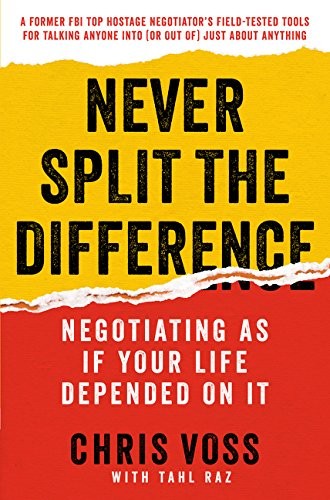
Never Split the Difference
BookC. Voss & T. Raz · 2016
The FBI's hostage-negotiation methods transposed to business and everyday life: tactical empathy, mirroring, labeling, calibrated questions. An emotional, counter-intuitive approach to persuasion.

Stalling for Time, My Life as an FBI Hostage Negotiator
BookG. Noesner · 2010
The account of twenty-three years of crisis negotiation at the FBI by the head of its unit. A demonstration of the power of listening, patience and de-escalation in the most tense situations.
Chris Voss, "Never Split the Difference", 2016, FBI crisis negotiation.
On video
Videos to picture The Black Swan Technique and anchor it through examples.
A verified video selection is being enriched; the search above already surfaces the best videos on the topic.
Technique map
Every technique sits within a network: what it draws on, what it combines with, where it applies, and how to defend against it.
Spot its signals, neutralise it and turn it around with the defensive playbook on this page.
See the counter-techniquesThe black swan is the hidden piece of information that, once uncovered, changes everything: a constraint, a secret motivation, an unknown deadline. Assuming that there is always at least one black swan on the other side, and actively searching for it, transforms a negotiation.
Propose an alternative frame that favours you, rather than enduring theirs.
Accepting the other side's ground without ever discussing it.
Our programmes turn theory into a concrete advantage.