
NEGOCOACH
257
Origin : FBI · Chris Voss

🕵️ FBI · Chris Voss

Tactical empathy

Chris Voss, "Never Split the Difference", 2016, FBI crisis negotiation.

Full detail in the “Origin & history” section below.

257

Tactical Empathy

Emotional intelligence Technique 257 / 360
Alexandre Baumberger

Author of the library

Alexandre Baumberger

Negotiation lecturer at KEDGE Business School

A rare threefold background serving negotiation: teaching, commercial justice and audit, backed by experience as a company director in Bordeaux.

  • Teaching, KEDGE Business School Negotiation lecturer since 2014 (12 years).
  • Commercial justice, Commercial Court Judge from 2018 to 2026: litigation, then insolvency proceedings.
  • Audit & advisory, over 20 years Tax, employment and financial audit in major firms, for large groups.
In brief

Tactical empathy consists in identifying and naming your counterpart's emotions out loud in order to defuse them and win their trust, without ever endorsing them on the substance. Popularised by former FBI negotiator Chris Vossi, it turns listening into a lever of influence: to understand precisely what the other person feels is already to begin steering the discussion.

Reading level

At a glance

Its family profile at a glance

Effectiveness Psychologicalimpact Discretion Preparation Relationalrisk Ethics
8.0 / 10 Tactical potential

Vigilance: moderate (4.0/10) · Preparation required: 6/10

Grounding in the source school School grounded in research and field practice

Indicative profile: it situates the “Emotional intelligence” family as the FBI · Chris Voss school practises it, not this technique taken in isolation. Techniques from the same family and school therefore share the same profile. NEGOCOACH editorial rating out of 10, non-experimental · the higher the “relational risk” value, the more costly the technique is to the relationship.

NEGOCOACH assessment

How to read this rating

Tactical potential 8.0/10 (effectiveness, impact, discretion) and vigilance moderate (relational and ethical risk): two distinct readings, deliberately never merged into a single score that would reward risk. NEGOCOACH editorial rating calibrated from the “Emotional intelligence” family and the “FBI · Chris Voss” school. Each criterion is rated out of 10; click to understand what it measures.

  • Effectiveness 8/10 · Very high

    How far the technique can carry the negotiation in the intended direction when it is well executed.

  • Psychological impact 10/10 · Very high

    Strength of the effect produced on the counterpart's perceptions, emotions and decisions.

  • Discretion 6/10 · High

    How hard it is for the other party to notice the technique is being used. A high value = very discreet.

  • Preparation 6/10 · High

    The information, analysis and rehearsal required upfront to use it effectively.

  • Relational risk 3/10 · Low

    Potential cost to the relationship and to trust if the technique is spotted, refused or fails. A high value = riskier.

  • Ethics 6/10 · High

    Moral acceptability: fairness, transparency and respect for the counterpart's autonomy. A high value = more defensible.

Level of evidence

School grounded in research and field practice

The school this technique stems from combines academic work with long field practice. This indicator qualifies the school, not this technique taken in isolation.

Indicative NEGOCOACH editorial rating, for teaching purposes. For “Relational risk”, a high value signals a cost to the relationship, not a quality.

Tactical Empathy in a nutshell


Origin & history

The technique was formalised by Chris Voss in Never Split the Difference (2016), drawing on his experience as lead hostage negotiator for the FBI. It rests on the FBI's Behavioral Change Stairway Modeli and extends Carl Rogers's work on empathetic listening and "unconditional positive regard" (1957).


Definition and principle

Where ordinary empathy seeks to feel the other's emotion, tactical empathy aims to understand and verbalise it in order to act upon it. The psychological principle is twofold: naming a negative emotion reduces its intensity (the affect labelling effect), while feeling understood triggers reciprocity and lowers defences. The goal is not to be nice, but to bring the other's guard down in order to obtain information and an agreement.


Concrete examples of application

Application by context

The same technique, across every negotiation settings

Context 1 / 8

Sales negotiation

A buyer digs in over the price. Rather than justifying, the seller names the emotion: "It sounds as if this budget puts you in an awkward position with your management." The buyer, feeling understood, reveals the real constraint: it is not the price, it is the internal sign-off deadline.

How to apply it

Open with a label ("It seems that…", "It sounds as if…") instead of a closed question, then stay silent. The silence pushes the other person to spell out their real constraint.

Strengths

Surfaces the hidden objection lurking behind the price; defuses tension without conceding a discount.

Weaknesses

A label that is overdone or recited rings false and triggers suspicion ("you're trying to play me").
Context 2 / 8

Procurement negotiation

On the buying side, facing a salesperson pushing hard to close quickly, the buyer names the pressure the seller is under: "I get the sense your whole quarter hinges on this contract." The salesperson, acknowledged, releases unsuspected room for manoeuvre on price and terms.

How to apply it

Label the seller's constraint (quarter-end, target, stock) to reveal their flexibility, then stay silent.

Strengths

Turns the seller's own tool against them and uncovers their walk-away point without disclosing your own budget.

Weaknesses

A salesperson well versed in the Voss method spots the device and may neutralise it in turn.

Context 3 / 8

Labour negotiation

In a tense union negotiation, management says: "It seems you feel that trust was betrayed during the last agreement." Acknowledging the feeling, without endorsing it, takes the heat out of the aggression and reopens dialogue on the substance.

How to apply it

Name the perceived collective emotion (anger, a sense of being disregarded) before turning to the figures; this drains the emotional abscess that was blocking the table.

Strengths

Restores a working climate; positions management as attentive, which then legitimises its own arguments.

Weaknesses

May be perceived as a communications ploy if no concrete action follows the acknowledgement.

Context 4 / 8

Crisis management

The technique's original context: facing a barricaded individual, the negotiator repeats the perceived emotions ("You feel that no one is listening to you, that you're cornered") until the tension subsides and a channel for dialogue opens.

How to apply it

String together labels and silences; offer no solution as long as the emotional intensity has not dropped (de-escalation before negotiation).

Strengths

The only approach that works when the other party is emotionally overwhelmed and deaf to any rational argument.

Weaknesses

Demands genuine composure and training; a misjudged emotional calibration can make the crisis worse.

Context 5 / 8

Political negotiation

In diplomatic mediation, a facilitator reframes one side's fear ("You are concerned that a withdrawal would be read as weakness by your public opinion") to show that its internal constraint has been heard, a precondition to any concession.

How to apply it

Label the face-saving constraint (reputation, public opinion) rather than the stated position; this is often the real sticking point.

Strengths

Unblocks stalled negotiations by addressing the image at stake, which is rarely stated explicitly.

Weaknesses

Sensitive ground: a poorly worded label can be exploited publicly by the other party.

Context 6 / 8

Real-estate negotiation

A private seller refuses any reduction. The agent names the attachment: "I sense that this price is also a way of honouring everything this house has meant to you." The seller, heard, becomes open to discussing terms rather than the figure alone.

How to apply it

Acknowledge the sentimental value before talking market; then shift the discussion towards the terms (timeframes, furniture) where margin exists.

Strengths

Detaches the negotiation from pure price by reintroducing trading variables.

Weaknesses

Ineffective against a purely rational or hurried seller, who expects market arguments.

Context 7 / 8

Cross-cultural negotiation

Between a direct Western negotiator and a partner from a high-context culture, naming an emotion too bluntly ("you seem angry") can cause loss of face. The negotiator adapts: they acknowledge the difficulty of the situation rather than the personal emotion, preserving harmony.

How to apply it

Tune the label to the cultural norm: in collectivist cultures, name the situation or the group, not the individual; favour allusion over direct statement.

Strengths

Avoids loss of face and shows respect for local codes, which accelerates trust.

Weaknesses

A label modelled on the codes of one's own culture may be experienced as intrusive or crude elsewhere.

Context 8 / 8

Family negotiation

During an inheritance dispute, one brother says to the other: "It sounds as if, behind the question of the house, you feel you have always carried the family without it ever being recognised." Naming the deep-seated feeling soothes, where arguing over shares would only have inflamed things.

How to apply it

Address the underlying emotion (recognition, emotional fairness) before the material division; it is what is blocking the agreement.

Strengths

Preserves the long-term relationship, a central concern in a family setting.

Weaknesses

Requires a neutrality that is hard to hold when you are yourself an emotionally involved party.


Counter-techniques

Spot and neutralise this technique

Negotiation is also played on defence. Here is how to recognise this technique when it is used against you, and turn it around.

Detect

The signals that give it away

  • Displayed empathy that lowers your guard
  • Mirroring of your gestures and words
  • A systematic "I understand you"

Neutralise

The counters that defuse it

  • Appreciate the warmth without relaxing
  • Keep your objectives in mind
  • Distinguish being heard from being satisfied

Turn around

Turn it into an advantage

Use active listening in turn to gather information.

The trap to avoid

Mistaking being understood for having won your case.

In brief

  • Difficulty: Intermediate
  • Estimated effectiveness: Very high
  • Time to implement: Short to phrase, long to master
  • Fields of application: Crisis negotiation, Sales, Management, Mediation, Diplomacy
  • Synonyms: Tactical empathy, Strategic empathy, Goal-directed active listening
  • Tags: empathy, labelling, active listening, Chris Voss, FBI

Strengths and weaknesses

Tactical empathy works where logic fails: it defuses the emotion that is blocking reason, gets the other person talking and reveals their true interests. It costs little and concedes nothing on the substance. Its limit: it demands genuine training; poorly executed (mechanical labels, a condescending tone), it produces the opposite effect and destroys trust.


When should you use this technique?

Use it whenever a strong emotion (fear, anger, distrust) is interfering with the negotiation, or at the outset to establish rapport. Avoid using it as mere window-dressing: without sincere listening behind it, the technique backfires. Pointless, even irritating, in a purely technical, unemotional transaction.


How to recognise and counter this technique

Recognise: your counterpart keeps naming your emotions ("it sounds as if…", "it seems you feel…") and follows each with pointed silences. Neutralise: acknowledge receipt without opening up further ("Noted, let's get back to the facts"), and steer the discussion onto objective criteria. Turn it around: use a label on their own emotion to regain the relational initiative.


Limits and ethics

The line between tactical empathy and emotional manipulation lies in intent and sincerity: exploiting another's distress to extract a concession is ethically indefensible. The risk of abuse is real in situations of vulnerability (bereavement, over-indebtedness). The rule: the acknowledgement of the emotion must be authentic and followed by consistent action.


Variants and related techniques

Combines directly with Labelling (naming the emotion) and Verbal mirroring (repeating the last words), the three key tools of Chris Voss. Close to Strategic validation and Relational calibration. Opposed to purely distributive negotiation and to a head-on show of force.


Going further

  • Chris Voss & Tahl Raz, Never Split the Difference: Negotiating As If Your Life Depended On It, 2016.
  • Carl Rogers, "The Necessary and Sufficient Conditions of Therapeutic Personality Change", Journal of Consulting Psychology, 1957.
  • Matthew Lieberman et al., "Putting Feelings Into Words: Affect Labeling Disrupts Amygdala Activity", Psychological Science, 2007.

Objectives of the technique

  • Defuse the counterpart's negative emotional charge by verbalising their emotions (labelling: "It sounds as if you're worried that…") before they block the discussion
  • Establish a climate of psychological safety that prompts the other party to reveal their real constraints, motivations and unspoken concerns
  • Obtain a "that's right", the signal that the other person truly feels understood, before advancing any proposal or request for a concession
  • Understand your counterpart's worldview (fears, status concerns, internal pressures) without endorsing it or sympathising, in order to steer the negotiation
  • Turn a confrontation into joint problem-solving and prevent escalation or breakdown

Famous cases

Judicial · Chase Manhattan Bank robbery (Brooklyn, 1993): A real case documented by Chris Voss himself (Never Split the Difference, ch. 2, and his MasterClass, with the recordings of the calls). Two robbers hold three employees hostage in a Chase branch in Brooklyn. Voss, the FBI's crisis negotiator in New York, takes the phone: a calm, deep voice ("late-night FM DJ voice"), mirror reformulations and labelling of the hostage-taker's emotions ("It sounds as if you don't want to come back out…", "This sounds like it was someone else's idea"). Without conceding anything on the substance, this display of understanding lowers the tension: the hostages are released and Voss obtains the surrender of the first hostage-taker. It is this kind of experience that led him to formalise "tactical empathy".

Sales · A furious client after a late delivery (representative scenario): A representative scenario (not attributed to real people). A procurement director threatens to terminate the contract after a second late delivery. Instead of justifying herself or reaching for a goodwill gesture, the key account manager labels first: "You feel we've put you behind everyone else, and now you're exposed internally after having defended us." The client exhales: "That's exactly it." The tension subsides, he spells out his real constraint, a deadline imposed by his own management, and the discussion swings towards a plan to secure the next deliveries rather than towards a breakup. Tactical empathy cost nothing and surfaced the information that made it possible to save the contract.


Common mistakes

  • Confusing tactical empathy with sympathy: it is neither about agreeing, nor being nice, nor commiserating, but about demonstrating a precise understanding of the other's perspective
  • Labelling mechanically ("It seems that…") without real listening: a formula slapped on or repeated sounds manipulative and destroys trust instead of creating it
  • Settling for a polite "you're right" instead of aiming for "that's exactly it": the former is often a signal of disengagement, not of shared understanding
  • Tipping into full emotional empathy and losing sight of your own objectives; research (Galinsky et al., 2008) shows that perspective-taking improves outcomes where affective empathy can degrade them
  • Launching straight into your proposal after the label, without letting the silence do its work or checking that the emotion has indeed subsided

Scientific foundations

  • Chris Voss & Tahl Raz (2016) Never Split the Difference: Negotiating As If Your Life Depended On It Harper Business (book)
  • Adam D. Galinsky, William W. Maddux, Debra Gilin & Judith B. White (2008) Why It Pays to Get Inside the Head of Your Opponent: The Differential Effects of Perspective Taking and Empathy in Negotiations Psychological Science, 19(4), 378-384, DOI: 10.1111/j.1467-9280.2008.02096.x
  • William Ury (1991) Getting Past No: Negotiating with Difficult People (the "Step to Their Side" concept) Bantam Books (book)

Quick exercise

Test yourself before answering

Answer in your head, then reveal the solution. Memory is built through active recall.

1 Quels signaux doivent vous alerter ?
  • Displayed empathy that lowers your guard
  • Mirroring of your gestures and words
  • A systematic "I understand you"
2 Quelles parades appliquer ?
  • Appreciate the warmth without relaxing
  • Keep your objectives in mind
  • Distinguish being heard from being satisfied

Frequently asked questions

The questions we get most

What is the "Tactical Empathy" technique?

Tactical empathy consists in identifying and naming your counterpart's emotions out loud in order to defuse them and win their trust, without ever endorsing them on the substance. Popularised by former FBI negotiator Chris Vossi, it turns listening into a lever of influence: to understand precisely what the other person feels is already to begin steering the discussion.

Is the "Tactical Empathy" technique ethical?

It sits on the line: effective, but it can tip into manipulation if it exploits an information asymmetry. Use it with measure and without deliberate deceit.

How do you defend against "Tactical Empathy"?

Mistaking being understood for having won your case. The right reflex: appreciate the warmth without relaxing.

What is the "Tactical Empathy" technique based on?

NEGOCOACH does not assess the experimental validation of this technique in isolation. What we document is the grounding of its source school (FBI · Chris Voss): school grounded in research and field practice. Full detail is in the "At a glance" section of this page.

Practise with AI

Three ready-to-use prompts

Copy, paste into your assistant, replace the [brackets]. Works with ChatGPT, Claude, Gemini, Mistral, Perplexity.

Prepare

Build your plan before the meeting

You are an expert negotiation coach. Help me prepare to use the "Tactical Empathy" technique in the following situation: [describe your situation]. Give me: the conditions for success, a 3-step script, my counterpart's likely objections and how to answer them.

Simulate

Rehearse against an AI counterpart

Play the role of my counterpart in a negotiation. I am going to test the "Tactical Empathy" technique. React realistically and with resistance, do not give in too quickly, then at the end analyse my performance and suggest 3 concrete improvements.

Debrief

Analyse a past negotiation

Here is how my negotiation went: [paste the exchanges]. Analyse whether the "Tactical Empathy" technique was used well, what worked, the mistakes made, and spell out precisely what I could have done better.

References

Bibliography & credible sources

Founding works of the 🕵️ FBI · Chris Voss school this technique belongs to.

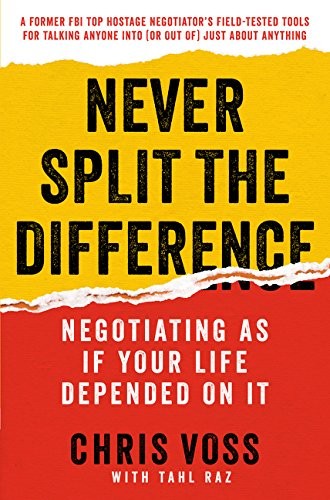
  • Cover: Never Split the Difference

    Never Split the Difference

    Book

    C. Voss & T. Raz · 2016

    The FBI's hostage-negotiation methods transposed to business and everyday life: tactical empathy, mirroring, labeling, calibrated questions. An emotional, counter-intuitive approach to persuasion.

  • Cover: Stalling for Time, My Life as an FBI Hostage Negotiator

    Stalling for Time, My Life as an FBI Hostage Negotiator

    Book

    G. Noesner · 2010

    The account of twenty-three years of crisis negotiation at the FBI by the head of its unit. A demonstration of the power of listening, patience and de-escalation in the most tense situations.

Chris Voss, "Never Split the Difference", 2016, FBI crisis negotiation.

On video

See the technique in action

Videos to picture Tactical Empathy and anchor it through examples.

Technique map

Where this technique sits

Every technique sits within a network: what it draws on, what it combines with, where it applies, and how to defend against it.

Levers engaged

biases & emotions

Countered by

Spot its signals, neutralise it and turn it around with the defensive playbook on this page.

See the counter-techniques

Key takeaways

  • En une phrase

    Tactical empathy consists in identifying and naming your counterpart's emotions out loud in order to defuse them and win their trust, without ever endorsing them on the substance. Popularised by former FBI negotiator Chris Vossi, it turns listening into a lever of influence: to understand precisely what the other person feels is already to begin steering the discussion.

  • The right reflex

    Use active listening in turn to gather information.

  • Never do this

    Mistaking being understood for having won your case.

8.0/10 tactical potential Moderate vigilance School grounded in research and field practice

This technique in action

Practical guides that put it to work, case by case.

All guides by situation

Master this technique in real situations?

Our programmes turn theory into a concrete advantage.

Explore our programmes
Call Book a call